
Search for social media marketing prices and you will find one agency quoting £200 a month and another quoting £3,000 — for what sounds like exactly the same thing. That spread is not a mistake, and it is not all mark-up. It reflects genuinely different amounts of work, skill and strategy hiding behind the same three words.
This guide breaks down what social media marketing actually costs in the UK, the pricing models you will be quoted under, and — the part most guides skip — what you are really paying for when you hand your accounts to someone else.
The short answer: UK social media marketing prices and rates
Most UK small and medium businesses spend somewhere between £300 and £1,500 a month on social media management, with the majority landing in the £500 to £1,000 range. Below that, you are usually buying basic scheduling. Above it, you are paying for strategy, video and hands-on management. Larger or content-heavy brands routinely spend £1,500 to £2,500 and up.
Two things muddy that picture. First, “social media marketing” covers everything from a freelancer posting three graphics a week to a full team running paid campaigns across five platforms — so a single average figure tells you very little. Second, if advertising is involved, the budget you give to Facebook or LinkedIn is separate from, and on top of, whatever you pay the person managing it. We will untangle both below.
At a glance, the main UK price bands look like this:
| Tier | Typical monthly range | What it typically buys |
|---|---|---|
| Entry level | £250–£500 | Light support on one or two platforms, a handful of posts and basic reporting |
| Mid tier | £600–£1,200 | Multiple platforms, custom graphics, some short-form video and light strategy |
| Premium | £1,500–£3,000+ | Full strategy, regular video, community management and reporting that tracks outcomes |
| Freelancer | £300–£600 | One person on a focused, single-platform brief; capacity is the trade-off |
The pricing models you’ll be quoted under
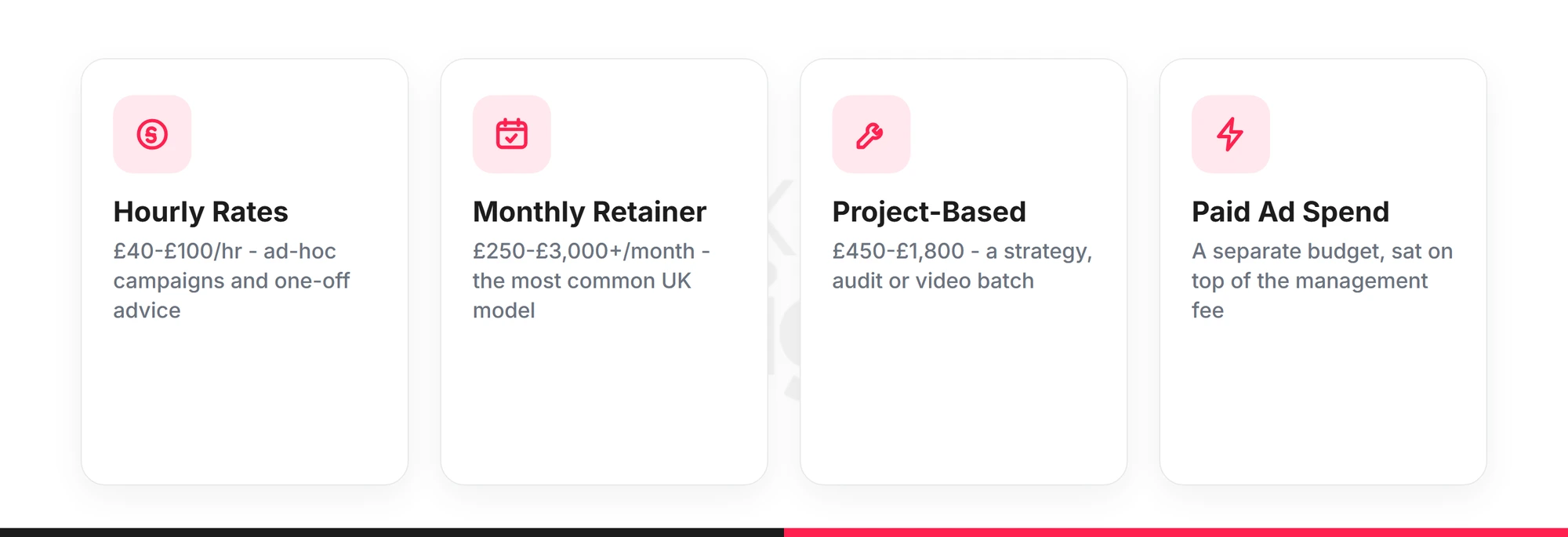
Before you compare numbers, understand the model behind them. UK providers price social media in four broad ways, and each suits a different kind of business.
Hourly rates
Freelancers and some consultants charge by the hour, typically £40 to £100 in the UK depending on experience. Hourly suits small, unpredictable needs — a one-off campaign, ad-hoc advice, or covering a busy patch. It gives you precise control over spend, but it rarely delivers consistency, because nobody is being paid to think about your brand between invoices.
Monthly retainers
This is the most common model, and the one most agencies default to. You pay a fixed monthly fee for an agreed scope of work. As a rough guide to the UK market:
- Entry level (£250–£500/month): light support, one or two platforms, a handful of posts, basic reporting.
- Mid tier (£600–£1,200/month): multiple platforms, custom graphics, some short-form video, light strategy and clearer reporting.
- Premium (£1,500–£3,000+/month): full strategy, regular video, community management, and reporting that tracks outcomes rather than vanity metrics.
A retainer buys predictability for both sides. Just make sure the scope is written down — the difference between “four posts a week” and “content as needed” is the difference between a fair price and an argument three months in.
Project-based work
Some work is better priced as a fixed project than an ongoing fee. A social media audit and strategy commonly runs £450 to £950. A standalone content plan sits around £600 to £1,000. A batch of short-form video clips can be £500 to £1,800, and full video production climbs well beyond that. Projects are useful when you want a foundation built — a strategy, a content library — that your own team can then run with.
Paid social: ad spend sits on top
This is where most of the confusion starts. When you run paid ads, there are two separate costs: the management fee (what you pay someone to plan, build and optimise the campaigns) and the ad spend itself (the money that goes straight to the platform). A £600 management fee with a £1,000 monthly ad budget is a £1,600 commitment, not £600. Reputable providers quote these two lines separately. If a quote blurs them together, ask for the split before you sign anything.
What your monthly fee actually pays for
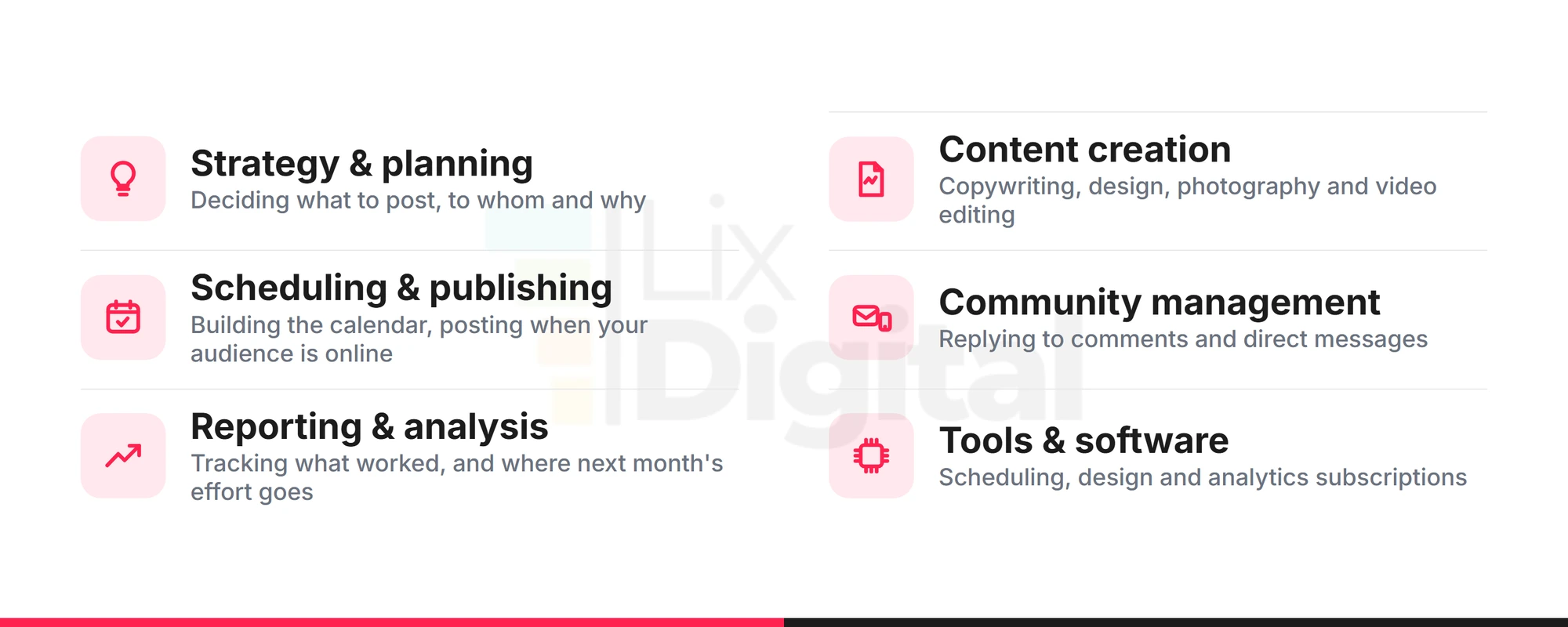
A retainer can look expensive until you see what sits inside it. Good social media management is not “posting” — posting is the last five minutes of a much longer job. A typical monthly fee covers some mix of:
- Strategy and planning — deciding what to post, to whom and why, then adjusting as results come in.
- Content creation — copywriting, graphic design, photography or short-form video editing. This is usually the biggest single chunk of the cost, because it is the most time-consuming and the most skilled.
- Scheduling and publishing — building the calendar and getting posts out at the times your audience is actually online.
- Community management — replying to comments and direct messages, which quietly eats hours for any business with an engaged following.
- Reporting and analysis — tracking what worked, what didn’t, and where next month’s effort should go.
- Tools and software — the scheduling platforms, design tools and analytics subscriptions the provider carries so you don’t have to.
When you compare quotes, you are really comparing how much of this list each one includes — and how experienced the person doing it is. A junior scheduling stock graphics and a senior marketer shaping a strategy can both be described as “social media management”. They are not the same purchase.
Organic vs paid social: two different budgets
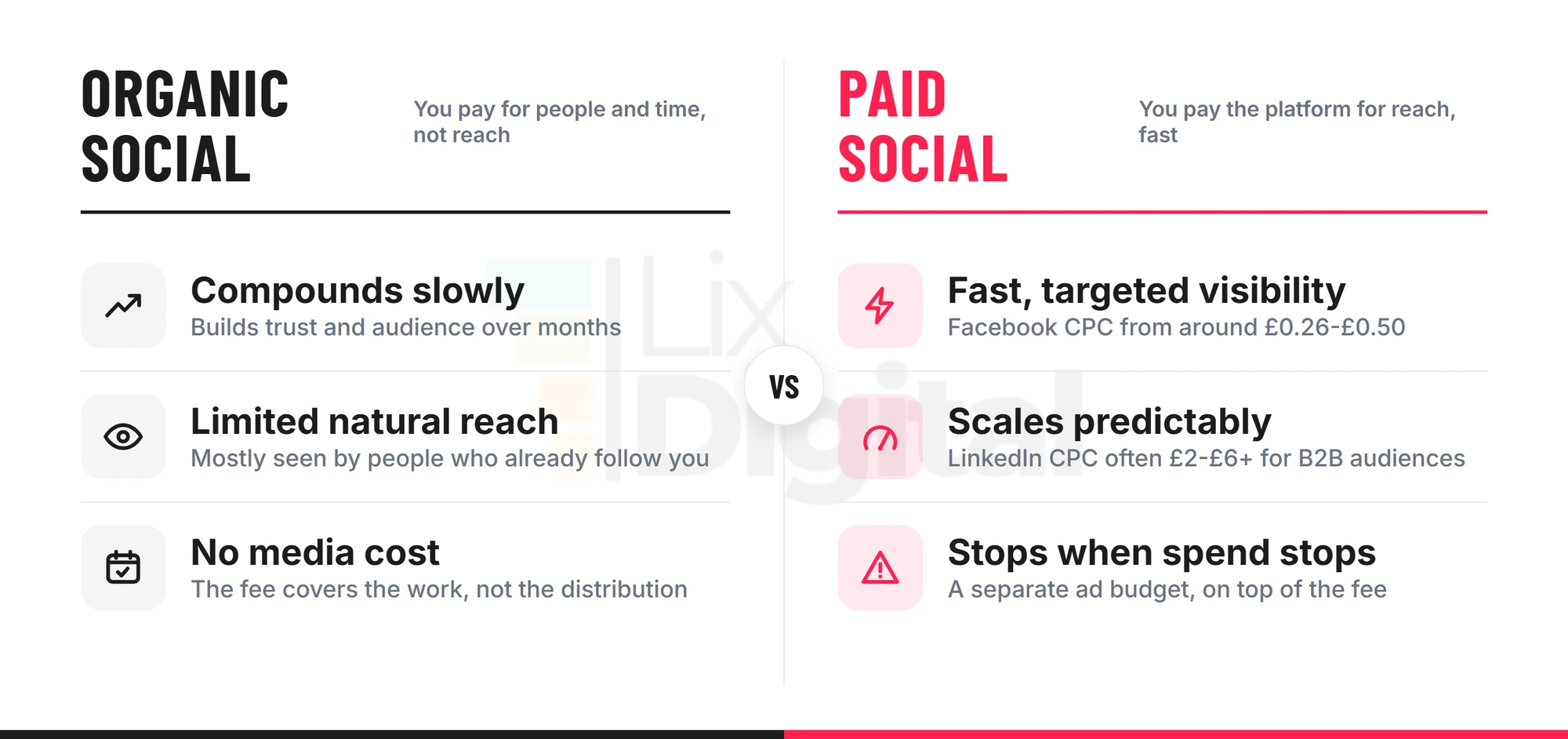
It helps to think of social media as two related but separate budgets.
Organic social is the ongoing work of building an audience through content you don’t pay to distribute — posts, reels, stories, community engagement. You pay for the people and the time, not the reach. It compounds slowly and builds trust over months.
Paid social is advertising: you pay the platform to put content in front of a chosen audience, fast. Costs vary by platform. As a rough UK guide, cost-per-click runs from around £0.26–£0.50 on Facebook to £2–£6 and up on LinkedIn, where the professional audience is in high demand. Paid gets you visibility quickly, but it stops the moment you stop paying.
Most businesses need a blend. Organic gives you a credible presence; paid accelerates specific goals like a launch or a lead push. If paid is part of your plan, treat the ad budget as its own line — and bear in mind it often overlaps with wider paid-search activity, which is why some businesses run their social ads and PPC under one joined-up strategy rather than in separate silos.
What drives the price up or down
Beyond the model, a handful of factors move a quote more than anything else:
- Number of platforms. Each one is its own format, audience and posting rhythm. Two platforms done well beats five done badly — and costs less.
- Posting frequency. More posts means more content to create, and content is where the cost lives. Daily posting is a different budget from twice a week.
- Content format. Graphics are quicker and cheaper than video. Short-form video and reels take real time to shoot and edit, and they carry a premium for good reason — they also tend to perform.
- Community management. If you want someone replying to every comment and DM, that is hours of work, and it shows in the price.
- Strategy depth. “Keep the account active” is cheap. “Grow the account towards a commercial goal and prove it with reporting” costs more, because it takes a more experienced head.
- Your sector. Competitive, regulated or B2B niches take more skill to market well, which nudges the price up.
Agency, freelancer or consultant: what each one charges
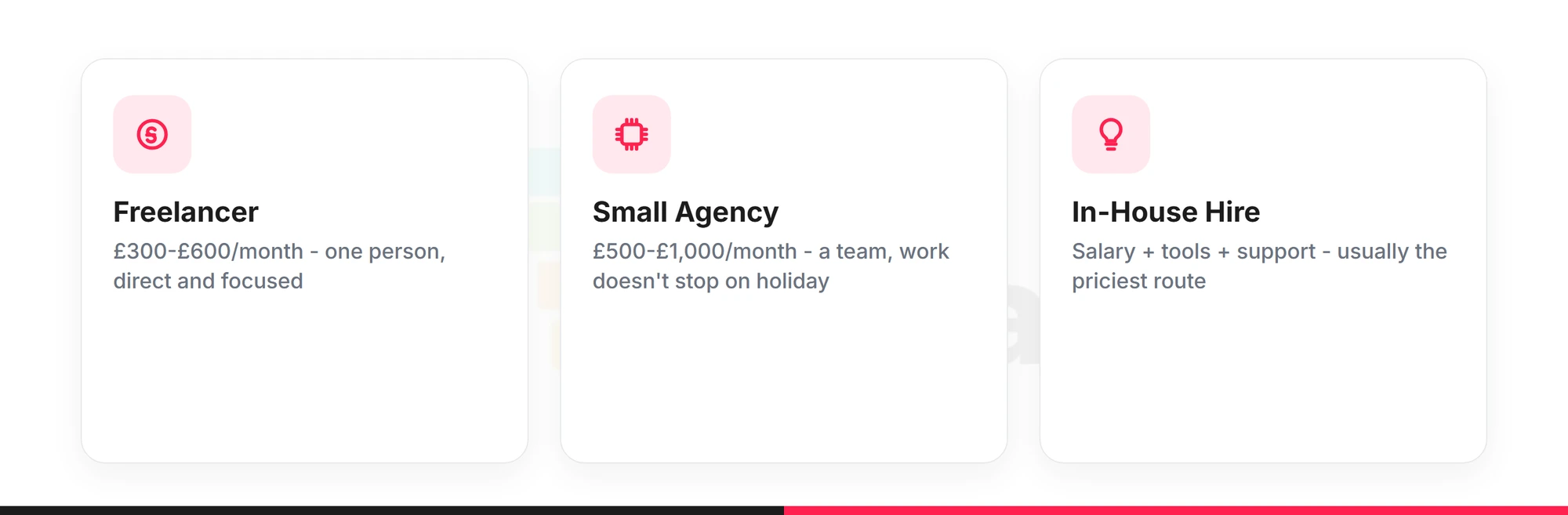
Price alone doesn’t tell you which route is right. As a rough UK picture:
A freelancer (often £300–£600 a month) can be excellent value for a focused, single-platform brief, and you deal directly with the person doing the work. The trade-off is capacity — one person covering strategy, design, video and holiday cover is a lot to ask of a single pair of hands.
A small agency (roughly £500–£1,000 a month) brings a team, so design, copy and strategy sit with different specialists and the work doesn’t stop when one person is away. A senior-led agency (from around £1,000+) adds strategic direction and accountability — social treated as a commercial channel, not a content calendar to fill.
A social media consultant sells direction rather than day-to-day delivery. Consultant fees are usually charged by the hour, typically within the same £40 to £100 band freelancers work to, or as a fixed project, where an audit and strategy commonly runs £450 to £950. What you get is a strategy, an honest review of what is and isn’t working, and a plan someone else carries out. That makes a consultant the right buy when you have a person in-house to post but nobody to steer; if you need the work done every week, a retainer fits better.
Hiring in-house is the option people forget to price properly. A capable social media manager’s salary, plus the software, plus the design and video support they’ll still need, usually comes to more than an agency retainer — and you carry the recruitment and cover risk yourself. For most SMEs, that maths is exactly why outsourcing wins until the workload justifies a full-time hire.
Red flags: when cheap gets expensive
Cheap social media isn’t always bad, but rock-bottom pricing usually means a corner is being cut somewhere. Be cautious when:
- A quote promises “full service” for £150–£200 a month. At that price something has to give, and it is usually strategy — often it means recycled templates and AI-spun captions with no one really steering the ship.
- Nobody can tell you what you’re paying for. A fair provider itemises the work. If the scope is vague, the value usually is too.
- You’re locked into a long contract from day one. Confidence in the work tends to show up as flexibility, not a twelve-month tie-in.
- The reporting is all likes and follower counts. Vanity metrics are easy to grow and easy to hide behind. Ask how the work ties to enquiries, bookings or sales.
Spending more doesn’t guarantee results either. The goal isn’t the cheapest quote or the most expensive one — it’s the one where the price and the scope make honest sense together.
How to brief for an accurate quote
The fastest way to a fair, comparable quote is to give every provider the same clear brief. Before you ask for pricing, get these straight:
- Your goals. “More brand awareness” and “twenty qualified enquiries a month” lead to very different plans and prices. Be specific about what success looks like.
- Your platforms. Where is your audience actually active? You don’t need to be everywhere.
- Your posting frequency and format. Roughly how often, and do you want video or just graphics?
- Whether you want community management. Replying to comments and DMs, or posting only?
- Whether paid ads are in scope, and a rough ad budget if so.
- Any brand assets you already have. Logos, photography, tone-of-voice guidelines — these save setup time, and can save you money.
Hand that to three providers and the quotes become genuinely comparable. Without it, you are comparing prices for different jobs and wondering why they don’t line up.
Where social media fits alongside your other channels
Social media rarely works its hardest in isolation. The businesses that get the most from it tend to have their channels pulling in the same direction — the website the traffic lands on, the search visibility that brings people in, the ads that amplify the best-performing posts. When those are joined up, each one makes the others work harder, and you’re not paying separate teams to redo the same groundwork.
That is the thinking behind working with a full-service agency rather than a single-channel supplier. As a UK generalist agency covering SEO, PPC, web and WordPress development, social media and hosting, we plan social as one part of a wider growth picture, not a standalone cost — and we report on it plainly, with no long tie-in contracts and pricing built around what your business actually needs. You can see how we approach social media management as a service, explore the full range of what we do across our services, or get in touch for a no-obligation chat about what a sensible budget looks like for your goals.
Frequently asked questions
How much does social media marketing cost per month in the UK?
Most UK small and medium businesses pay between £300 and £1,500 a month, with £500 to £1,000 being the most common range for consistent, strategic management. Larger or content-heavy brands often spend £1,500 to £2,500 and above. The right figure depends on your platforms, how often you post, and how much strategy and video you need.
Is the advertising budget included in the price?
Usually not. Paid social has two separate costs: the management fee you pay the agency or freelancer, and the ad spend that goes to the platform itself. A £600 management fee with a £1,000 ad budget is a £1,600 monthly commitment. Always ask for the two figures separately so you know the true total.
Do social media prices include VAT?
Not always, so check. Many agencies and freelancers quote fees excluding VAT, and a VAT-registered provider will add 20% on top. It’s a common reason a quote feels higher than expected — clarify whether the number you’ve been given is inclusive of VAT or not before you compare it with anyone else’s.
Is a freelancer cheaper than an agency?
Often, yes — freelancers typically start around £300 a month against £500-plus for a small agency. But you’re comparing capacity as much as price. A freelancer is one person covering everything; an agency spreads the work across specialists and doesn’t stop when someone’s on holiday. The cheaper option isn’t automatically the better-value one.
How much should a small business budget for social media?
A common guideline is to put 12–20% of total revenue into marketing, with social media taking a share of that. In practice, many small businesses start at £500 to £1,000 a month for management, plus a modest ad budget if paid is part of the plan. Start at a level you can sustain for several months — social rewards consistency, not short bursts.
Why is social media management so expensive?
Because the visible part — the post — is the last step of a much longer job. You’re paying for strategy, content creation, video editing, community management and reporting, plus the tools and the experience behind them. The price reflects skilled time, not a few graphics. That said, a fair provider should always be able to show you exactly what your fee covers.
Final thoughts
There is no single price for social media marketing in the UK, and any guide that gives you one number is oversimplifying. What matters more than the headline figure is the match between what you’re paying and what you’re actually getting — a clear scope, honest reporting, and work that ties back to your business goals rather than a follower count. Get the brief right, insist on transparency, and the pricing tends to explain itself. If you’d like a straight answer on what a sensible budget looks like for your business, we’re happy to talk it through.