Three UK web agencies quoting for what sounds like the same website will routinely come back with £900, £3,200 and £11,000. None of them is necessarily overcharging. They have each assumed a different job for the site to do, and nobody wrote that job down.
The honest middle of the UK market is this: a professional five-to-ten page business website costs £2,000 to £5,000 to build, plus £300 to £1,500 a year to keep running. A single scrolling page starts nearer £300. An online shop runs from £2,500 well into five figures. Building it yourself on a website builder costs £100 to £400 a year and takes your weekends instead.
Every one of those figures is broken out below: what drives the build price, what the bill looks like after launch, what you own once the invoice is paid, and what a rebuild can quietly cost you in search rankings. Our own web development service is priced on the same logic.
What a website costs in the UK: the short answer
Prices sort themselves by who does the work more neatly than by anything else. This is the current spread across the UK market.
| Who builds it | Build cost | Running cost a year | Suits |
|---|---|---|---|
| DIY website builder | £0 – £300 | £100 – £400 | Sole traders, side projects, a placeholder |
| Freelance designer | £500 – £3,000 | £150 – £600 | A professional look on a tight budget |
| Regional or remote agency | £2,000 – £6,000 | £600 – £1,500 | Sites that have to produce enquiries |
| Design studio | £3,000 – £10,000 | £500 – £1,200 | Growing businesses, first online shops |
| London or premium agency | £5,000 – £15,000+ | £1,000 – £3,000+ | Larger organisations, complex needs |
| Custom web application | £10,000 – £50,000+ | £2,000 – £10,000+ | Portals, booking platforms, bespoke work |
The least reliable number there is the cheapest one. On a website builder, the headline subscription commonly accounts for only a quarter to two-fifths of what you actually spend once a domain, a business email address and the paid apps are added.
Independent research into UK small business pricing puts the average five-page professional build at around £2,000, with a typical floor of £1,500 and a ceiling of £3,000. Treat that as a sanity check: a quote for a straightforward small business site arriving at £400 or at £9,000 has something unusual in its specification, and it is worth asking what.
Price the job your site has to do, not the page count
Most price guides tier websites by size — five pages, ten pages, twenty pages. It is the wrong axis. A five-page site that has to take bookings, confirm them automatically and drop them into a diary costs more than a fifteen-page brochure that only has to load quickly and read well on a phone.
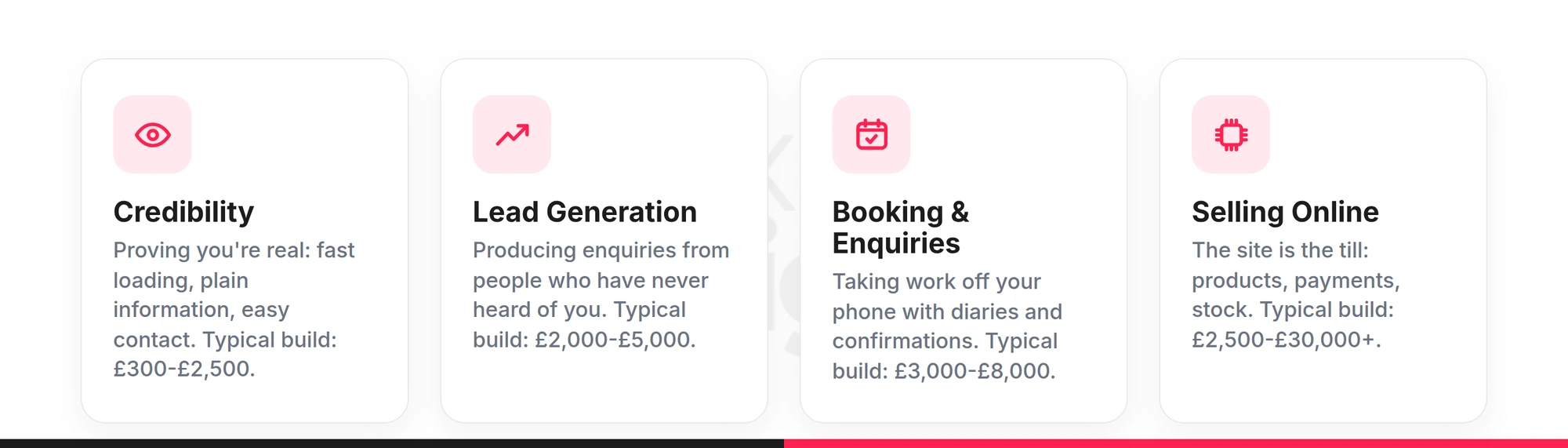
Work out which of these four jobs yours has to do. That one decision explains most of the gap between quotes.
| The job | What it has to be good at | Typical UK build | What pushes it up |
|---|---|---|---|
| Credibility. Someone has your name and is checking you are real. | Loading fast, saying plainly what you do, being easy to contact | £300 – £2,500 | Photography; bespoke design over a customised template |
| Lead generation. It has to produce enquiries from people who have never heard of you. | A page per service, persuasive copy, forms that work, being findable in search | £2,000 – £5,000 | Number of service pages, copywriting, technical SEO foundations |
| Booking and enquiry handling. It has to take work off your phone. | Diary integration, automatic confirmations, enquiries routed somewhere useful | £3,000 – £8,000 | Booking system £500 – £2,000; each integration £300 – £2,000 |
| Selling online. The site is the till. | Product data, payments, shipping, VAT, returns, stock accuracy | £2,500 – £30,000+ | Product count, payment and shipping integrations, card fees |
Sector guides say the same thing in another language: a trades business is quoted £1,000 to £3,000, a restaurant or construction firm £2,000 to £5,000, an accountant or solicitor £4,000 to £10,000, a small retailer £3,000 to £8,000. The trade label is not what moves the number — a solicitor pays more because the site has to establish authority and feed a case-management system.
Write your job down in one sentence before you ask anyone for a price. “It needs to bring in enquiries for four services across England and Wales, and I want to update the blog myself” is a brief. “I need about eight pages” is not, and you will get eight pages of something.
Who builds it: DIY, freelancer, studio or agency
With the job defined, the second lever is who does the work. The honest version of each route beats a pitch for any of them.
DIY on a website builder — £100 to £400 a year
Wix, Squarespace and GoDaddy plans run from about £2 to £259 a month, with the everyday small business tiers around £9 to £22. Neither entry-level Wix nor entry-level Squarespace includes a custom domain or a business email address, so add £8 to £25 a year for the domain and £3 to £10 a month per mailbox. The cost you cannot invoice is time: most owners spend two to four weekends on a first DIY site. The platforms also cap what you can do about search — Squarespace restricts metadata editing beyond the homepage, and Wix will not let you edit robots.txt. Fine for a placeholder, frustrating once the site has to compete.
Freelance designer — £500 to £3,000
A straightforward four or five page build lands at £1,200 to £2,000 in two to six weeks, with no agency overhead in the price. Budget another £100 to £300 a year for the domain, hosting and maintenance most freelancers charge separately. The risk is concentration: one person is one illness away from a stalled project, and if they move on there may be nobody who understands how your site was assembled. Ask who covers the work if they cannot, and get the handover documented.
Studio or agency — £2,000 to £15,000
Regional and remote agencies quote £2,000 to £6,000 for a business site, studios £3,000 to £10,000, London firms £5,000 to £15,000 and up. Hourly rates run £100 to £150 and beyond in London, £50 to £80 in Manchester, Leeds or Bristol, £40 to £70 in Scotland, Wales and Northern Ireland, and £50 to £90 for remote teams. Since nearly all of this work happens over video calls and shared documents, a national agency working remotely is usually the same standard at closer to regional rates. We work with businesses right across the UK on that basis.
Treat hourly rates as useless for comparison regardless. One widely quoted estimate puts a typical small business website at twelve weeks of agency labour, which at published UK rates spans £6,000 to £96,000 for the same brief. Ask for a fixed price against a written specification instead.
What is actually inside the build price
A build quote is a bundle of separate jobs. Knowing the going rate for each tells you whether a total is fair, and where to cut if it is not.
- Design. An off-the-shelf theme with your content dropped in sits at £1,000 to £1,500. A customised design on a sensible structure is £1,200 to £3,000. Genuinely bespoke, custom-coded design starts nearer £5,000. For most small businesses a well-customised template wins on value, and no visitor has ever noticed the difference.
- Copywriting. £200 to £500 a page through an agency, £80 to £150 from most freelance copywriters. The line most often struck out to hit a budget, and the one that most often decides whether the site works.
- Photography. A commercial shoot runs £300 to £1,500; stock subscriptions £20 to £150 a month. Real photographs of your premises, team and finished work beat stock every time on a service business.
- Functionality, priced item by item. Booking system £500 to £2,000. Payment processing £300 to £1,500. Customer accounts or a portal £1,000 to £5,000. On-site search £500 to £2,000. Each integration with a CRM, accounts package or stock system £300 to £2,000.
- Technical SEO foundations. A crawlable structure, one clear H1 per page, editable titles and descriptions, fast loading, mobile-first layout, a sitemap. Standard in any professional build. Ongoing search work is a separate service at £500 to £1,500 a month and should be quoted separately.
- Training and handover. An hour showing you how to edit your own pages saves paying someone £75 an hour to change a phone number.
The compliance items that belong in the build
A UK business website needs a privacy policy, a cookie notice that gets consent before setting non-essential cookies, terms and conditions, and — if you trade as a limited company — your registered company name and number where a visitor can find them. Website builders supply templates for some of that and check none of it.
Accessibility is the item most quotes ignore entirely. The Equality Act 2010 requires businesses to make reasonable adjustments so disabled people can use their services, and to anticipate that need rather than wait for a complaint. WCAG 2.2 Level AA is the practical standard used to demonstrate it: sixty-three testable criteria covering alternative text, a minimum 4.5:1 contrast ratio, keyboard navigation and screen reader compatibility. Automated tools catch only 30 to 40 per cent of real issues and a full specialist audit is a five-figure exercise, which is why building accessibility in during design costs far less than retrofitting it later. Ask whether it is in the specification. Usually it is not.
The bill that arrives after launch
The build is a project. A live website is a standing subscription to several small things at once, and this is the part that catches people out. Every line below has a price and a consequence.
| Item | Typical UK cost | What happens when it lapses |
|---|---|---|
| Domain registration | £8 – £25 a year | The site and every email address on the domain stop working. After the grace period, anyone can register it. |
| Hosting | £10 – £50 a month, managed | The site goes offline. Some hosts delete the account and its data once a grace period expires. |
| SSL certificate | Usually included; £30 – £100 a year standalone | Browsers put a full-screen security warning in front of your homepage. |
| Maintenance and updates | £50 – £300 a month, or 10 – 15% of the build cost a year | Out-of-date core software and plugins are the most common route into a small business site. Cleaning one up costs more than a year of maintenance. |
| Premium plugin and theme licences | £30 – £100 each a year; £0 – £400 in total | The feature keeps working but stops getting updates, then breaks at a core update, usually without warning. |
| Backups | Often bundled; £5 – £20 a month standalone | Nothing at all, until the one day it matters. |
| Business email | £50 – £200 a year per mailbox | Mail stops arriving. Noticed faster than anything else on this list. |
| Content updates | Free yourself; £200 – £500 a page written | Nothing breaks. The site quietly drifts away from what you actually sell. |
Together these routinely add 30 to 80 per cent to the headline build in year one. A £3,000 build is realistically £4,000 to £5,500 by the end of its first twelve months, then £1,000 to £2,000 a year after. Monthly: a basic site runs £16 to £82, a business site £91 to £261, an online shop £160 to £502 and up.
Shops carry one line that never appears on a build quote — card fees. Stripe charges 1.5% plus 20p on UK cards, PayPal 1.2% plus 30p, WorldPay 2.75% plus 20p. On £5,000 of monthly sales that is roughly £120 to £150 a month, permanently.
Two practical notes. HMRC generally treats the design and build as capital expenditure and the ongoing items as allowable business expenses, so ask your accountant how to book them. And where a business runs an SEO campaign with us, hosting on our UK servers is included for as long as they are with us, which removes one line from that table — whoever you use, ask what happens to your site if you leave.
What you actually own when it is finished
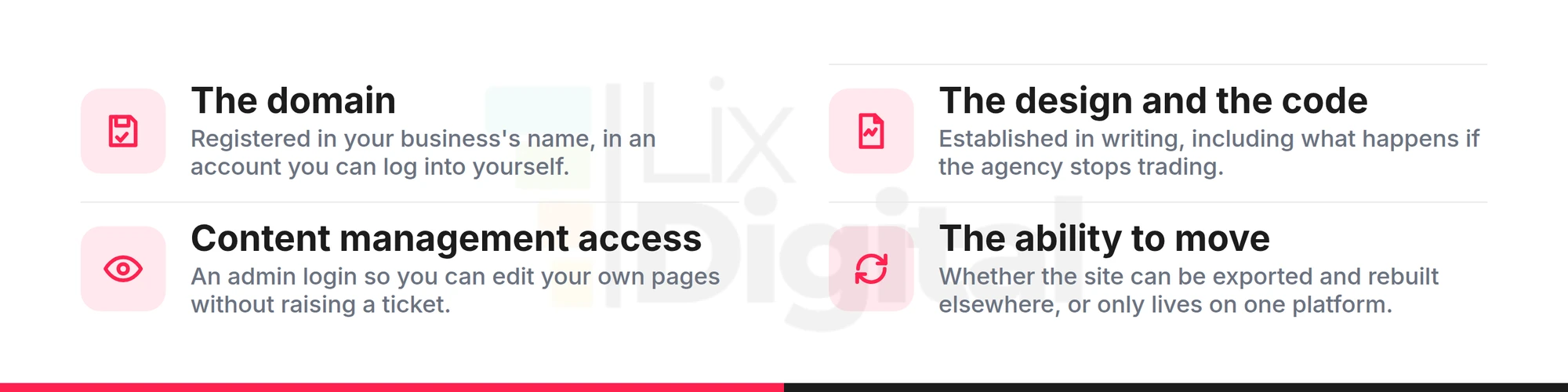
Paying for a website does not automatically mean owning one. Under UK law, copyright in the design stays with the designer unless the contract explicitly transfers it, which makes ownership a clause rather than an assumption. Four things to establish in writing before you pay a deposit.
- The domain. Registered in your business’s name, in an account you can log into yourself. If your designer registers it under their own account, your web address is theirs — the most expensive item here to get back.
- The design and the code. Agencies building on their own reusable frameworks often licence those components to you rather than transferring them. That is legitimate and usually cheaper for you, but it needs writing down, along with what happens to your site if the agency stops trading.
- Content management access. On any CMS-built site you should hold an administrator login and be able to edit your own pages. If you cannot change a price without raising a ticket, you are renting.
- The ability to move. The one that catches people out later.
That last point separates the routes more sharply than price does. A site built on Wix or Squarespace cannot be exported and moved elsewhere — the design lives inside the platform, and when you stop paying, the site stops existing. Outgrowing a builder therefore means rebuilding: professional migration off one costs £500 to £5,000, plus three to six months of reduced search traffic while Google re-indexes the replacement.
A self-hosted WordPress site is different in kind. The files and the database are yours and can be copied to any host in an afternoon, which is a large part of why WordPress runs roughly 62 per cent of the world’s content-managed websites. Over three years it is usually the cheapest mainstream option too — around £378 in platform costs, against roughly £612 for Squarespace and £788 for Wix once email is counted. That is how we build: yours to keep, on any host.
Rebuilding an existing site: the cost nobody quotes for
If you already have a website that gets found in Google, the biggest risk in a redesign is not the invoice. It is landing a handsome new site that ranks for less than the old one did, and realising three months later when the phone has gone quiet.
It happens because a rebuild changes everything a search engine uses to recognise your pages — the addresses, the titles, the headings, the wording, the internal links — usually all at once, and usually without anyone treating that as part of the job. Badly handled migrations are already known to cost three to six months of depressed traffic. Nothing in a design quote protects you from it.
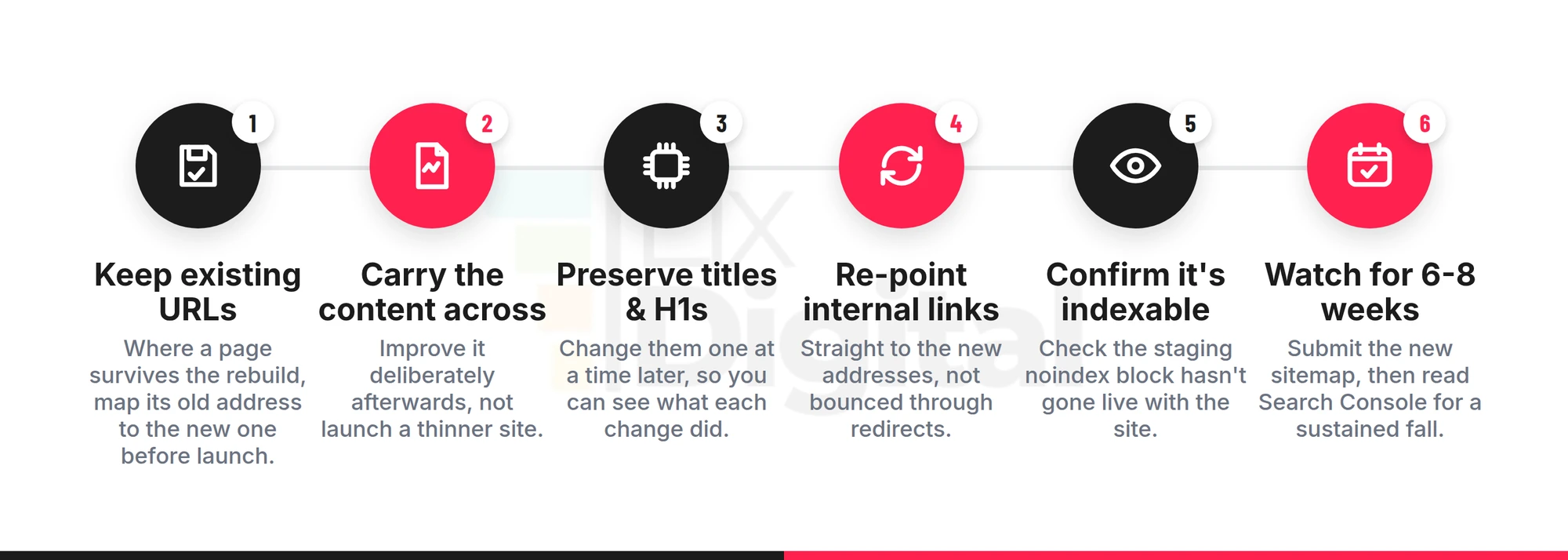
Because we do both — build sites and then have to make them rank — a rebuild reads here as two pieces of work rather than one. The second piece is a short, unglamorous checklist.
- Keep the URLs you already have. If a page survives the rebuild, its address should survive too. Every URL you change is a redirect you then maintain indefinitely.
- Map old to new before launch, not after. Export every existing URL, put its replacement beside it, and set a permanent 301 for each. Anything without an obvious equivalent goes to the closest relevant page, never to the homepage. Redirecting a whole old site to the homepage is the most common rebuild mistake there is, and search engines treat those pages as though they simply vanished.
- Do not lose the content. A tidier site with half the words on the page that was bringing in the enquiries is a downgrade in a better typeface. Carry the substance across, then improve it deliberately.
- Preserve the titles and H1s that already work. Change them afterwards, one at a time and on purpose, so you can see what each change did.
- Re-point the internal links. Links inside your own site should go straight to the new addresses rather than bouncing through redirects.
- Check the new build is indexable before it goes live. Staging sites are normally blocked from search engines, and that block going live with the site is a common and expensive slip.
- Watch it for six to eight weeks. Submit the new sitemap, then read the coverage and query reports in Google Search Console. A fortnight of movement after launch is normal; a sustained fall is a fault to fix, not a settling-in period.
Ask any agency quoting for a redesign whether the redirect map and post-launch monitoring are included, and what they cost if not. It is the quickest way to find out whether the people rebuilding your site understand what it currently does for you. Where rankings are the point of the exercise, bring the search side into the brief from the first conversation rather than the week after launch.
Why the cheapest build is rarely the cheapest website
Build price is not the number that matters. What matters is what each enquiry ends up costing you, and that depends on how many visitors do something once they arrive. Here is the sum nobody puts in a price guide.
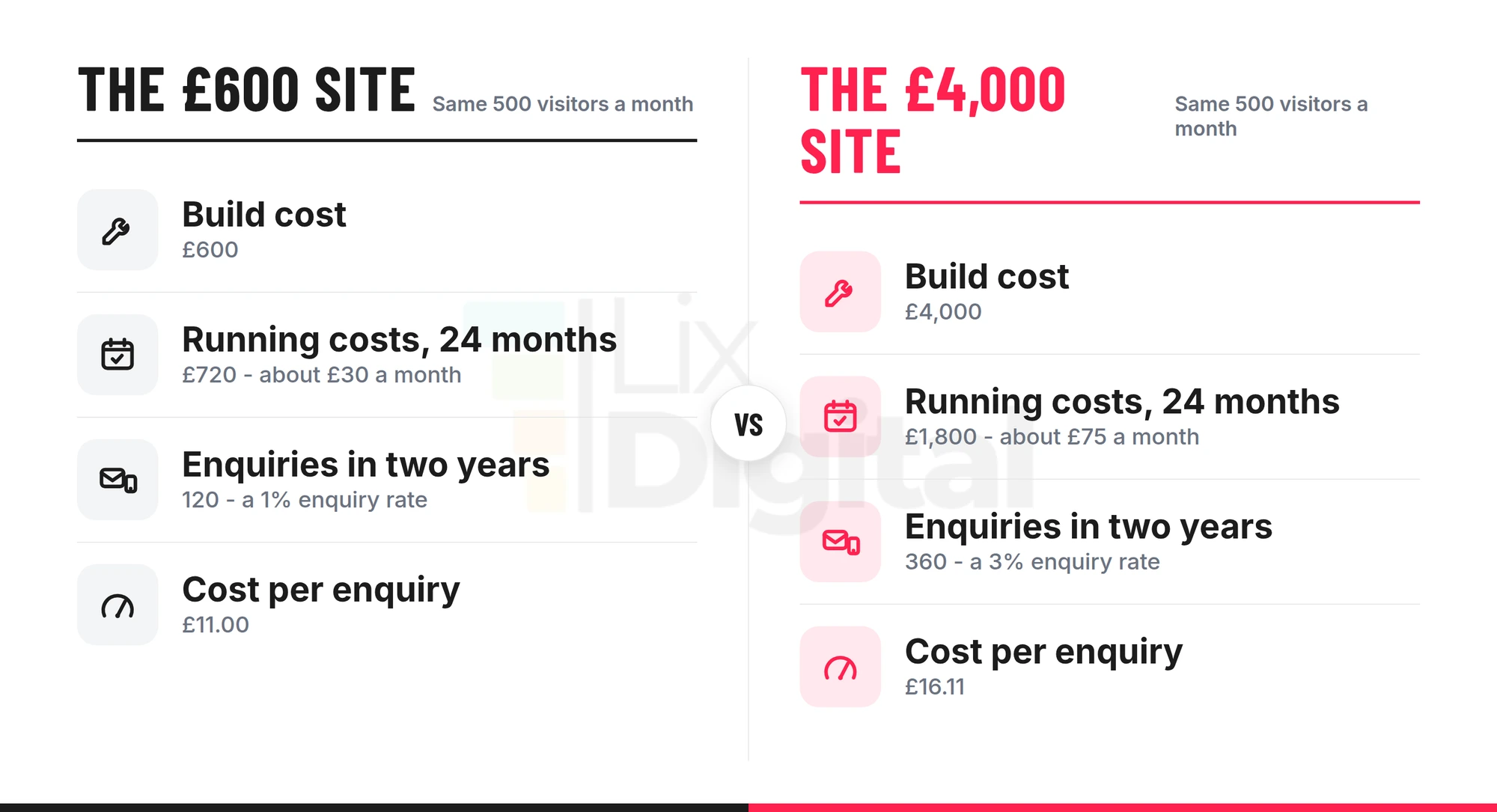
Take two sites receiving identical traffic of 500 visitors a month. One cost £600, the other £4,000. Assume the cheap one turns 1 per cent of visitors into an enquiry and the properly built one 3 per cent. Those are assumptions rather than measurements, but they are ordinary ones.
| Over two years | The £600 site | The £4,000 site |
|---|---|---|
| Build | £600 | £4,000 |
| Running costs, 24 months | £720 (£30 a month) | £1,800 (£75 a month) |
| Two-year total | £1,320 | £5,800 |
| Visitors a month | 500 | 500 |
| Enquiry rate | 1% | 3% |
| Enquiries in two years | 120 | 360 |
| Cost per enquiry | £11.00 | £16.11 |
Read that carefully, because it does not say what you expect. Per enquiry, the cheap site is cheaper. What it does not do is produce the enquiries — 120 against 360 over the same two years, from exactly the same traffic.
So the real question sits at the margin. The better site costs £4,480 more and delivers 240 extra enquiries: about £18.67 for each additional one. At a one-in-three win rate that is roughly 80 more jobs. Whether 80 jobs are worth £4,480 to you is a question only you can answer — but it is the right question, and it is not the same question as which quote is cheaper.
Two things bend the sums further. The cheap site rarely does hold traffic level, because the platforms that make cheap sites possible are the ones that restrict how you optimise them. And a £600 site that has to be replaced in eighteen months costs £600 plus the replacement, so you buy a website twice.
We are not neutral on this, and it is worth saying why. Alongside the agency we own and run our own automotive brands — ECU Repairs, Turbo Repairs and Bodyteq — so builds like these have been paid for out of our own trading accounts and then judged on whether the enquiries turned up. Sitting on the buying side of the table changes what you think is worth paying for, and what is decoration.
What to budget, and when to spend it
A common benchmark puts total marketing at 5 to 10 per cent of annual turnover, with the website taking 10 to 30 per cent of that. For a business turning over £300,000 that is £15,000 to £30,000 on marketing and £1,500 to £9,000 on the site — which is why the £2,000 to £6,000 band keeps reappearing.
- Starting out — £500 to £2,000. A clean, fast, mobile-friendly site carrying your core information and a contact route that works. Upgrade later.
- Established and growing — £3,000 to £8,000. Proper design, a page per service, technical SEO foundations, lead capture that converts. Where a site starts paying for itself.
- Scaling — £8,000 to £25,000 and up. Ecommerce, integrations with the systems you already run on, bespoke functionality.
You do not have to buy all of it at once. Phasing works: get the essential pages live and findable, add the blog, testimonials and booking once analytics show what visitors actually want, then spend on conversion improvements where the data points. Each phase earns the next, which beats betting the whole budget on day-one guesses.
One caveat on sequencing. A new site takes weeks to build and months to earn search visibility, so if you need enquiries before then, that gap is what paid channels are for. Running paid search while the site and its rankings build is often a better use of the same money than a bigger build — we break the figures down in our guides to PPC costs in the UK and social media marketing costs.
Timelines and payment terms: what is normal in the UK
A five to ten page business site takes four to eight weeks from brief to launch. A freelancer on a simple build can manage two to six. Ecommerce and bespoke functionality run twelve to twenty weeks. At the template end, done-for-you services will put a basic site live within 72 hours of receiving your content.
Which points at the real cause of delay: projects overrun on content, not code. If your copy, photographs, price lists and legal pages are ready before the build starts, you will hit the timeline. If they are not, no agency can hit it for you.
- Fixed price against a written specification, usually paid in stages — a deposit, a payment at design sign-off, the balance at launch. Gives you budget certainty and gives both sides something to point at when scope starts moving.
- Time and materials, billed hourly. Sensible for open-ended work and later changes, poor for a first build, because the risk of a bad estimate sits entirely with you.
- Pay monthly. Around £90 a month is typical for a five-page site, from about £40 for a single page to £300 for a small shop. It removes the upfront cost, usually costs more across two or three years, and in most of these deals the site is not yours. Read what you are left holding if you stop paying.
How to read a web design quote
Two quotes are only comparable when both list the same things. A proper quote itemises all of the following, and asking for the missing lines usually explains the price gap by itself.
- Page templates, not just page count — the design work sits in the templates, so twenty pages on four templates is a smaller job than eight pages on eight.
- Whether copy is written for you or supplied by you, and for how many pages.
- Photography: supplied, stock, or shot.
- Every piece of functionality named and priced separately.
- Every integration named, with the system it connects to.
- Rounds of revision included, and the rate for further ones.
- Which technical SEO work is inside the build, and what ongoing search work costs as a separate service.
- On a rebuild: the redirect map and post-launch search monitoring.
- Hosting — whose, what it costs, what it includes.
- Maintenance after launch: what is covered, response times, and the rate for anything outside it.
- Who owns the design, the code, the content and the domain.
- A timeline with stage dates, and what happens if content arrives late.
- The total, the VAT position, and the payment schedule.
And the signals worth walking away from:
- Guaranteed search rankings. Nobody can guarantee a position in a result set they do not control.
- Your domain registered in their account. Not a grey area — ask them to change it before anything else happens.
- No content management access on a site built with a content management system.
- A “professional website” for £200. Somebody absorbs that difference, and it will be you, later.
- No written scope. Every argument about a website project is ultimately an argument about scope.
- A long lock-in with no exit terms — monthly fees, the agency owning everything, nothing on paper about how you leave.
One structural question worth putting to any shortlist. Where the build, the hosting and the search work sit with one supplier, nobody can blame the other party when traffic drops: accountability is in one place and the reporting either shows progress or it does not. That is how our services are arranged, and it is a fair thing to ask of agencies that only do one of the three.
Website costs in the UK: frequently asked questions
How much does a website cost in the UK?
A professional five-to-ten page business website costs £2,000 to £5,000 to build, with £300 to £1,500 a year to keep running. A single page starts around £300, a freelancer build runs £500 to £3,000, and online shops range from £2,500 to £30,000 and beyond. DIY on a website builder costs £100 to £400 a year.
How much does a small business website cost in the UK?
Independent research puts the average five-page small business build at about £2,000, typically between £1,500 and £3,000. Freelancers commonly quote £1,200 to £2,000 for that specification, regional and remote agencies £2,000 to £6,000, and London agencies 30 to 50 per cent more for the same brief.
How much does a WordPress website cost?
Run yourself, a WordPress site costs roughly £36 to £432 a year for hosting, domain, theme and any premium plugins. Built for you, it costs the same as any professional build — £2,000 to £5,000 for a typical business site. Over three years WordPress is usually the cheapest mainstream route at around £378 in platform costs, against roughly £612 for Squarespace and £788 for Wix.
How much does website maintenance cost in the UK?
Budget £50 to £300 a month, or 10 to 15 per cent of the build cost a year. That covers core and plugin updates, security patching, backups and small content changes. Ecommerce sites sit at the upper end. Hosting, domain renewal and premium plugin licences are separate lines on top.
How much does a website redesign cost, and will it affect my Google rankings?
A redesign costs much the same as a new build for the same specification, and moving off a website builder adds £500 to £5,000 in migration work. It can absolutely affect rankings — badly handled migrations lose three to six months of traffic. The protection is a full old-to-new URL map with 301 redirects, unchanged URLs wherever the page survives, content and titles carried across rather than trimmed, and Search Console watched for six to eight weeks after launch.
How long does it take to build a website?
Four to eight weeks for a five to ten page business site, two to six weeks for a simple freelancer build, twelve to twenty weeks for ecommerce or bespoke functionality. Delays are nearly always caused by content arriving late rather than by development, so have copy, photographs and price lists ready before the build starts.
Final thoughts
The number you want does not exist in the abstract. A website costs what the job you have given it costs, plus what keeping it alive costs, minus whatever you are willing to do yourself. Once you can describe that job in a sentence, quotes stop looking arbitrary and start looking comparable.
Three things to carry into the conversation: define the job before you ask for a price, add the running costs to every figure you compare, and check what you own at the end. Get those right and £2,000 spent deliberately will beat £6,000 spent vaguely. Our web development work is quoted line by line against a written specification, hosted on UK servers with UK-based support, and built so you can move the site to any host you like.