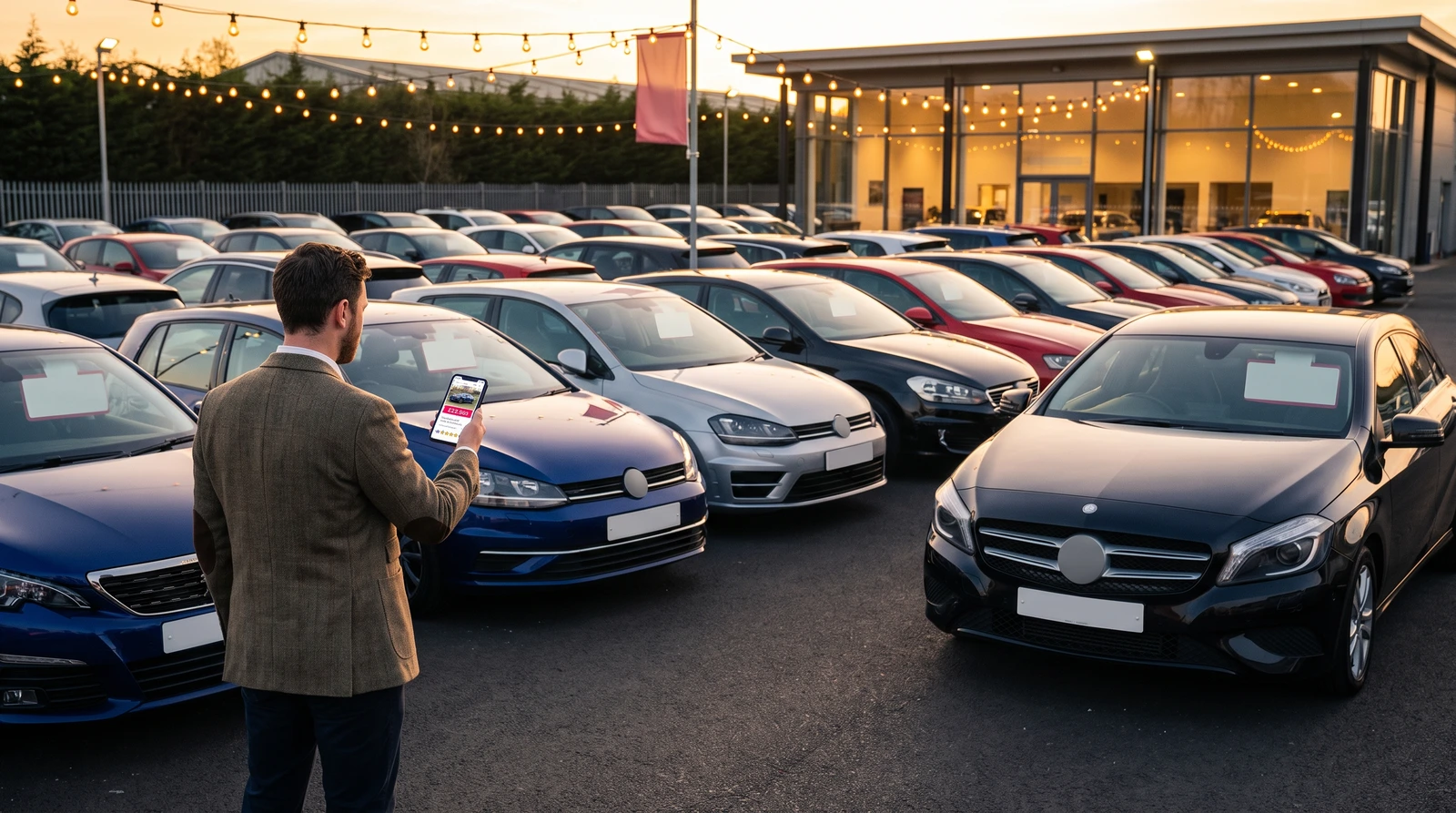
A car dealership is really two businesses sharing one forecourt. One sells a vehicle today. The other keeps that owner coming back for servicing, MOTs, tyres and, three or four years on, their next car. Most dealership marketing pours its budget into the first job and quietly neglects the second — which is where the steadier, higher-margin money tends to sit. Good marketing works both sides at once. This is a plain-English guide to marketing a UK car dealership properly: how buyers actually shop now, where your own website earns its keep against the big marketplaces, how to advertise stock and finance without falling foul of the rules, and how to turn a single sale into years of aftersales visits. It comes from a team that runs its own automotive brands, so it is grounded in how the motor trade really works rather than generic marketing theory.
How UK car buyers actually shop now
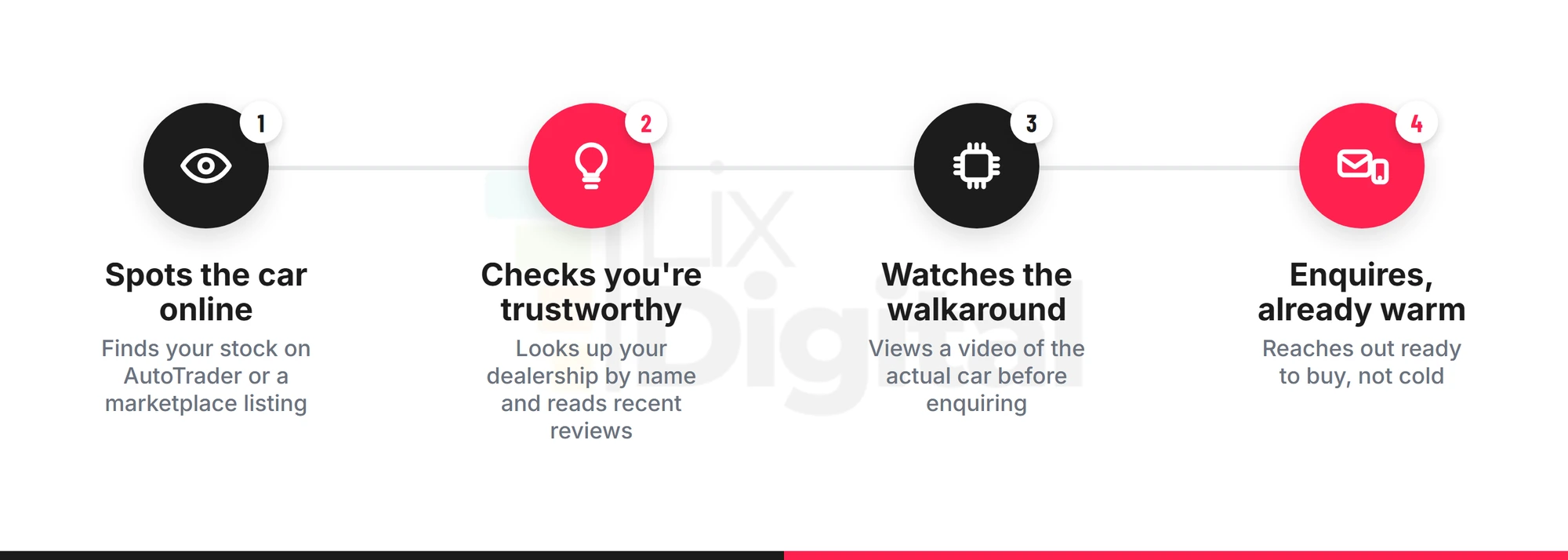
By the time a buyer walks onto your forecourt or picks up the phone, they have usually done most of their deciding online. They have browsed AutoTrader and the marketplaces, searched the make and model they want, watched a few walkaround videos, read your reviews, and quietly compared you against two or three other dealers nearby. The visit is the end of the journey, not the start of it. That shift changes what marketing has to do: your job is no longer just to be on the forecourt, but to win the research phase that happens on a phone screen days or weeks earlier.
It also means a car sale is rarely decided by a single advert. A buyer might first spot your stock on a marketplace, look up your dealership by name to check you are trustworthy, watch a video of the actual car, and only then enquire. Each of those touchpoints either builds confidence or leaks it. The dealerships that consistently win are not necessarily the ones with the biggest ad budget — they are the ones whose stock, website, reviews and follow-up all pull in the same direction, so a cautious buyer never has a reason to drift to a competitor. Everything below is about making that happen deliberately rather than by luck.
Your website versus the marketplaces
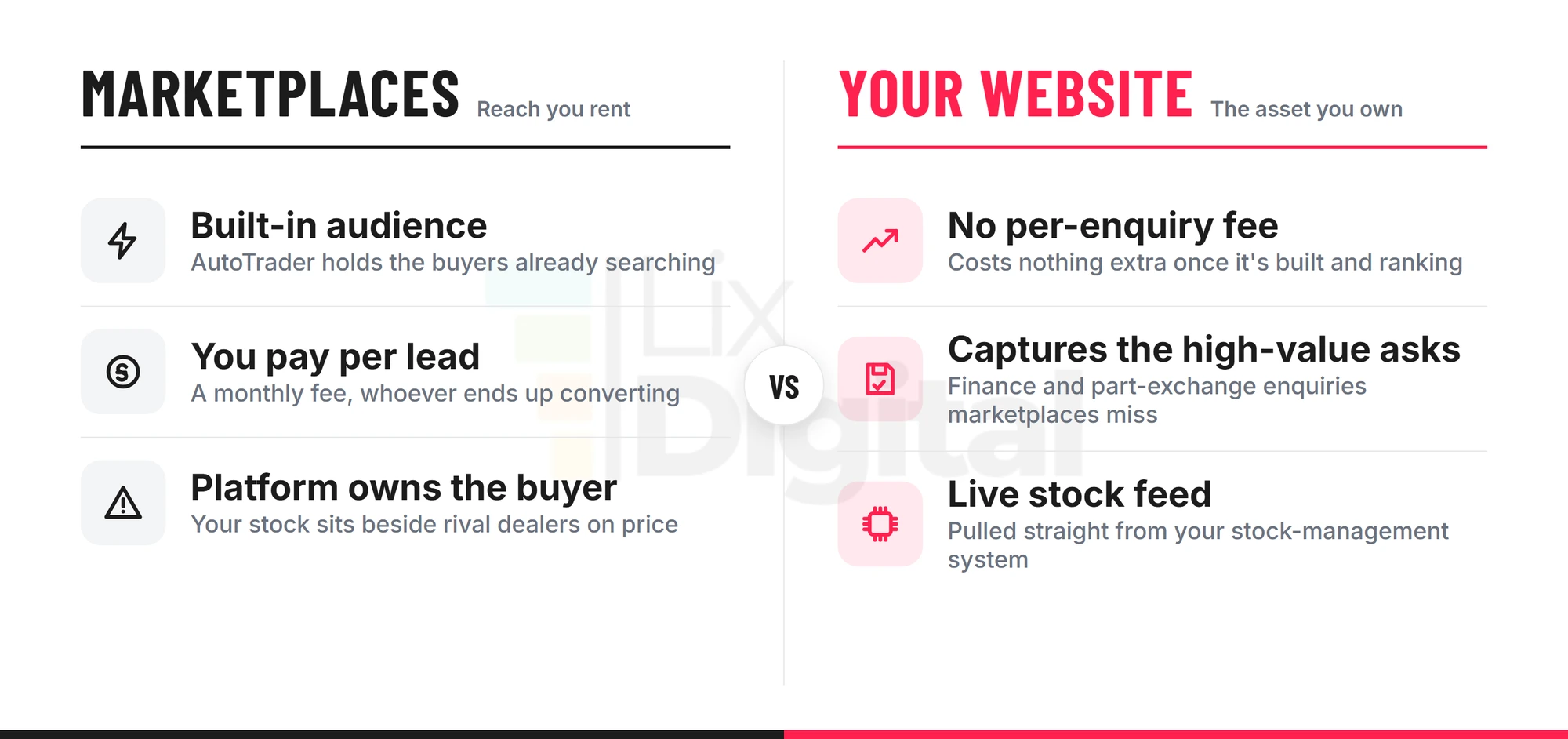
AutoTrader and the other marketplaces are unavoidable — they hold the audience, and for a lot of dealers they are the single biggest source of enquiries. But they come with a catch worth understanding. You rent that visibility monthly, the platform owns the relationship with the buyer, and your stock sits inches away from a dozen rival dealers advertising the same model, often nudging you toward price as the only lever. It is powerful reach, but it is reach you never own and cannot fully control.
Your own website is the opposite: slower to build an audience, but yours outright. A buyer who finds you directly is not staring at your competitors’ listings, is not costing you a per-lead fee, and is far more likely to enquire about finance or a part-exchange valuation — the higher-value conversations marketplaces rarely capture. The strongest position is not one or the other but both working together: use the marketplaces for reach, and make your own site the place buyers land when they look you up by name, ready to convert. In practice that means a fast, mobile-first website with your live stock pulled straight from your stock-management system via a feed, clear finance and part-exchange enquiry paths, and genuine trust signals — real photos, real reviews, real people. We build and host dealership websites in-house on UK-based servers with UK-based support, and there is more on how we approach that on our web development page.
How to advertise your forecourt and the stock on it
Advertise on two fronts at once: make the forecourt sell to anyone who drives past or walks on, and put every car on it in front of buyers online before they arrive. The physical side earns a second look; the online side is where most of the deciding happens, so both need to tell the same story.
Start with what a passer-by sees from the road. Keep the forecourt clean and the stock lined up so each car reads at a glance, and treat banners, flags and window graphics as live messages rather than fixtures: a faded flag or an expired offer tells people nobody is paying attention. Put a clear price card in every windscreen and mark cars as sold as they go, because visible movement shows buyers the stock turns over.
Many buyers shop to a monthly budget rather than a cash price, so a monthly figure on the car can pull them in. Once you quote one, though, it is a financial promotion, and the representative example rules in the finance section apply to a windscreen card as much as to an online advert.
The forecourt is also your photo studio. Shoot every car in the same spot, in good light and from consistent angles, showing the interior, the tyres and any marks honestly, then film a short walkaround before it goes live. Those images feed your website and every marketplace listing, so check the stock feed carries the full specification, the correct price and the whole gallery rather than a lone thumbnail; a sparse listing loses the click to a rival with a complete one.
Keep the price and finance figures identical on the windscreen, the listing and your website, so a buyer comparing them finds nothing to question. Then follow up the people who looked but did not enquire. The next section, on getting your stock found in search, covers how each vehicle page earns visibility of its own, while the paid search and paid social section covers retargeting, showing a car again to someone who has already viewed it.
Getting your stock and name found in search
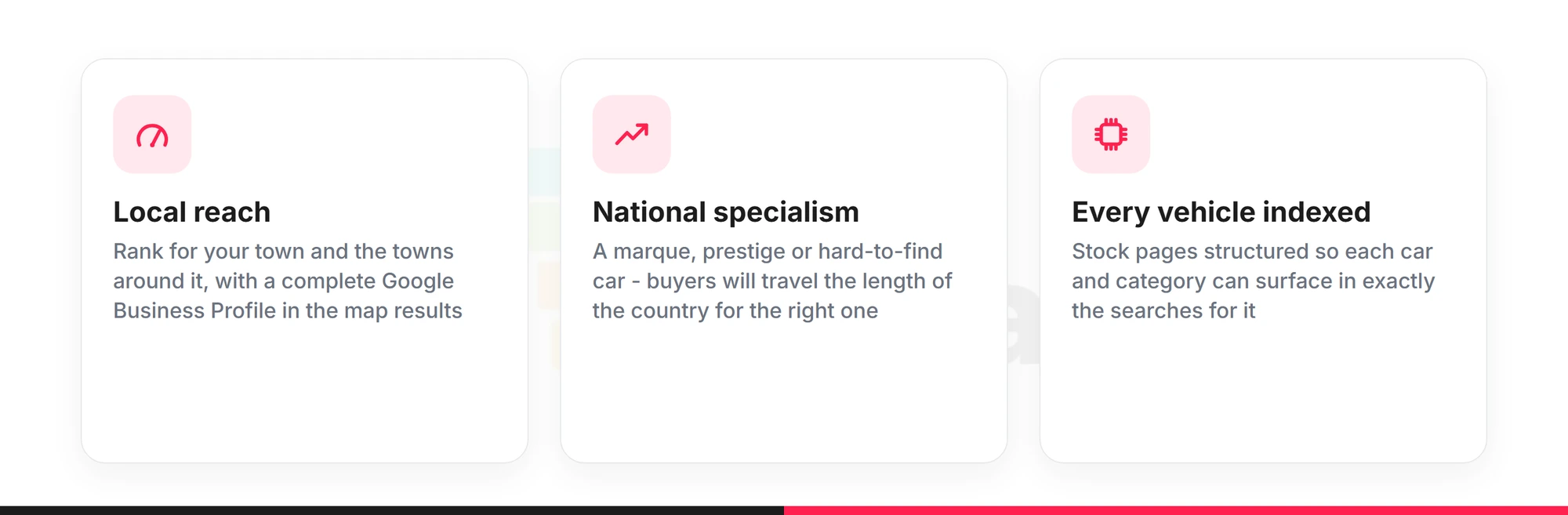
Search sits underneath almost everything else. When a buyer types “used [make] [town]”, “[make] dealer near me”, or simply your dealership’s name into Google, you want to be there — and where you appear depends on work you can genuinely influence. A dealership’s search presence has two halves that matter. The first is local: most buyers are willing to travel a sensible radius for the right car, so ranking for your town and the towns around it, and appearing in the map results with a complete, well-kept Google Business Profile, puts you in front of people at the exact moment they are choosing where to buy.
The second half is national, and it is easy to miss. If you specialise — a particular marque, prestige or performance stock, vans, wheelchair-accessible vehicles, classics — buyers will travel the length of the country for the right one, and your stock pages can rank nationally for those specific searches. A well-structured site gets each vehicle and category indexed so it can surface in exactly those queries. This blend of local reach and national specialism is something we set up and sharpen for automotive clients, because a dealership’s catchment is rarely just its postcode. Our SEO services page explains how we approach it — for your own dealership’s visibility, not ours.
Paid search and paid social for car dealers
Organic search and reputation compound slowly; paid advertising buys visibility today, which makes it useful in the right circumstances and wasteful in the wrong ones. On Google, the highest-intent money is in search ads for terms like “used cars [town]” or model-plus-finance searches — people actively shopping right now. Beyond that, retargeting quietly earns its keep: a buyer who viewed a specific car on your site and then sees it again as they browse is being reminded of a decision they were already close to making. On Meta, Facebook Marketplace and dynamic stock ads put individual vehicles in front of local buyers scrolling with no particular plan, which is a different, more discovery-led kind of demand.
The discipline that separates profitable ad spend from a drain is honesty about when it is worth it. Ads suit a newer dealership with little organic footing, a specific slice of ageing stock you need to move, or a competitive patch where the top of Google is hard to reach organically in the short term. They are usually not worth it when a sale’s margin cannot absorb the cost per click, or — most commonly — when nothing tracks which enquiries and sales the ads actually produced, so you are spending money you cannot measure. We recommend paid campaigns only where they fit your stock, margins and goals, and manage them so every pound is accountable. Our PPC management page covers how we run them.
Advertising car finance without falling foul of the FCA
Here is the part most marketing guides skip entirely, and it is the part that can cost a UK dealership dearly. The moment your advertising promotes finance — a monthly figure, a deposit, “0% APR”, “finance available” — it becomes a financial promotion, and financial promotions are regulated. Firms that broker or advertise consumer car finance must be authorised by the Financial Conduct Authority (FCA) or act as an appointed representative of a firm that is. This is not marketing best practice; it is the law, and it applies to your website, your social posts and your marketplace listings alike.
The core rules are simpler than they sound. Every financial promotion must be fair, clear and not misleading. If your advert quotes finance terms that trigger the requirement — an interest rate, or incentives like a low deposit or monthly payment — it must show a representative example, including the representative APR, given at least equal prominence to the eye-catching figure. You cannot imply finance is guaranteed for everyone, bury the real cost in small print, or dress up an interest rate as “free”. Under the FCA’s Consumer Duty, you also have to be able to show the customer was treated fairly and given the information they needed to decide. The safe approach for any dealership is to treat finance advertising as a compliance question first and a marketing question second — get the wording signed off against your permissions, and build your website and ad templates so the required detail is baked in, not bolted on. It is exactly the sort of sector-specific pitfall we watch for when we handle marketing for the motor trade.
Reviews and reputation: the dealership trust economy
Few industries carry as much inherited suspicion as car sales. Buyers arrive braced for the hard sell and the hidden fault, which makes reviews less of a nice-to-have and more of a deciding factor. A wall of recent, genuine reviews — on Google, on AutoTrader, wherever your buyers look — does two jobs at once: it lifts how prominently you appear in local results, and it reassures a nervous buyer far more convincingly than anything you can say about yourself. When two nearby dealers have similar stock at similar prices, the one with a stronger, more recent review profile usually gets the enquiry.
The dealerships that win here make asking part of the routine rather than an afterthought — a genuine request at handover when the buyer is happiest, a follow-up message with a direct link, and the same habit after every service, not just every sale. Reply to reviews too, especially the critical ones; a calm, fair response to a complaint reassures the next reader more than an unblemished score with silence. And never be tempted by bought or fake reviews. They are easy to spot, against platform rules, and they corrode the exact trust you are trying to build in a trade where trust is already hard-won.
Aftersales is the real prize: service and MOT retention
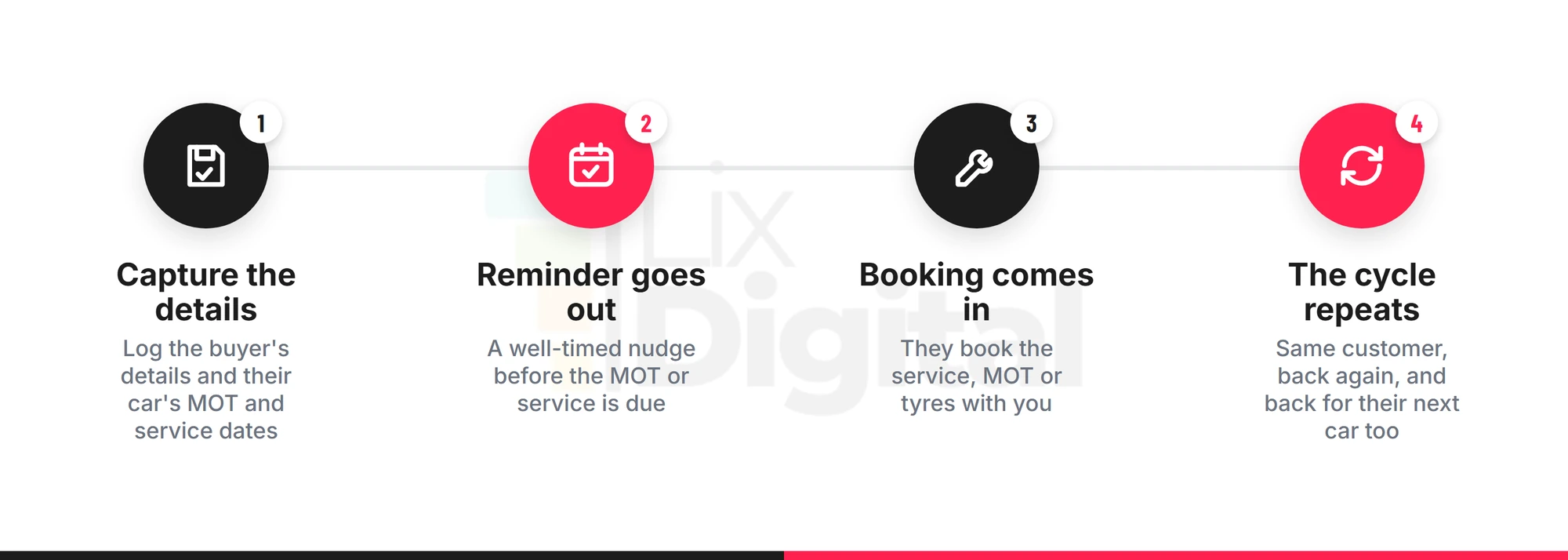
This is the section most dealership marketing forgets, and it is where the quiet, reliable money lives. Selling a car is a one-off event; servicing, MOTs, tyres and repairs are a relationship that can last years and often outweighs the margin on the original sale. Yet many dealers wave the customer off with the keys and never deliberately market to them again. The opportunity is a retention engine built on data you already hold: capture every buyer’s details and their car’s MOT and service dates in your system, then send a friendly, well-timed reminder before each is due, alongside service plans that spread the cost and lock in the return visit. It costs very little, it reaches people who already trust you, and it turns a single transaction into a customer who comes back on a schedule — and who is far more likely to buy their next car from you too.
This is not theory to us. The repeat-service side of a dealership works much like the workshops we run ourselves — ECU Repairs, Turbo Repairs and Bodyteq are our own automotive brands, not clients we picked up, and the reminder and retention cycles described here are ones we operate in practice. A dealership’s sales floor is its own discipline, but the aftersales engine is familiar ground, and it is consistently the cheapest, highest-return marketing an automotive business has. If your workshop side is your priority, our companion guide on digital marketing for garages goes deeper on that specific corner of the trade.
Social media and video, kept realistic
Social media unsettles a lot of dealership owners because they imagine having to become entertainers. For a car dealership it is far more practical than that — it is where stock gets seen and character gets shown. Short video does the heavy lifting: a clean walkaround of a fresh arrival, an honest thirty-second look at a car’s condition, a handover moment, a quick clip of the workshop. Video sells cars because it answers the questions a static photo cannot, and because a buyer who has effectively already viewed the car online arrives warmer and more committed.
You do not need to be everywhere. Pick the one or two platforms your buyers actually use — Facebook and its Marketplace for local reach and community, with Instagram or TikTok worth it for visual, video-led stock — and post consistently rather than sporadically across all of them. The aim is not viral fame; it is to be a visible, credible dealership that buyers recognise and half-trust before they ever enquire. If keeping that up alongside running the business is one job too many, it is exactly the kind of work an agency can take off your hands. Our social media management page explains how we handle it.
Measuring what actually sells cars
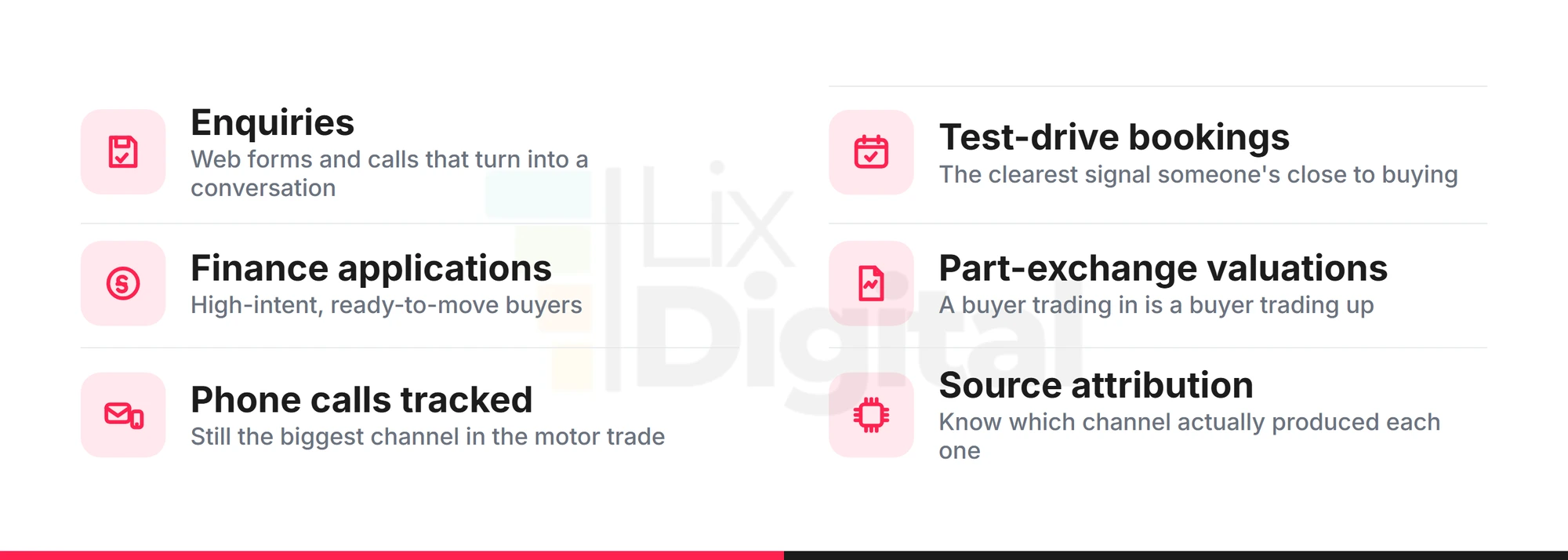
The difference between marketing that works and marketing you resent paying for usually comes down to whether you can see what it produces. Likes, impressions and follower counts feel like progress but they do not shift metal. The numbers that matter to a dealership are more grounded: enquiries, test-drive bookings, finance applications, part-exchange valuations, and phone calls — and crucially, which channel produced each one. Phone still matters enormously in the motor trade, so calls belong in your tracking, not just web forms.
Once you can attribute enquiries and sales to their source, every decision gets easier: you back the channels that bring buyers and cut the ones that only bring noise. That is the whole game — not more activity, but activity you can measure and improve. We work in a white-hat, transparent way with clear reporting on what has been done and what it is bringing back, measured in enquiries, bookings and sales for your dealership rather than vanity numbers. Marketing you cannot measure is how dealers end up concluding, wrongly, that “marketing doesn’t work”.
Car dealership marketing questions, answered
How much should a car dealership spend on marketing?
There is no honest flat figure, because a single-site used-car dealership and a multi-franchise group are different problems. The sensible approach is to work backwards from the cost of the enquiries and sales your marketing produces, not to pick a percentage blind. Start by getting the fundamentals earning — your website, your search visibility and your marketplace listings — measure what each returns, then scale the channels that pay their way. Tell us about your dealership and we will give you a straight view of what is worth funding first.
Is AutoTrader worth it, or should I just build my own website?
For most dealers it is not a choice between the two. The marketplaces give you reach and buyer volume you cannot easily replicate, but you rent that reach and share the buyer’s attention with rivals. Your own website is the asset you own — cheaper per enquiry over time, better at capturing finance and part-exchange conversations, and the place buyers land when they look you up by name. The strongest position is both: marketplaces for reach, your own site to convert the buyer once they are seriously interested.
How do I get more used-car leads quickly?
Paid advertising is the fastest lever — well-targeted Google search ads and Facebook Marketplace stock ads can bring enquiries within days, which is why they suit clearing specific stock or launching a site. But quick and lasting are not the same thing: ads stop the moment you stop paying. The durable work is the search visibility, reviews and aftersales retention built underneath them, so the strongest approach is usually both at once — paid for the immediate enquiries while the compounding channels build.
Do I really need to worry about FCA rules if I advertise finance?
Yes. If your advertising promotes finance in any form, it is a regulated financial promotion, and it must be fair, clear and not misleading, with a representative example and representative APR shown where the rules require it. Firms brokering consumer car finance also need to be FCA-authorised or an appointed representative. It is genuinely easy to breach these rules by accident with an eye-catching monthly figure, so treat finance wording as a compliance question first — check it against your permissions and build the required detail into your site and ad templates from the start.
Should I market the dealership in-house or use an agency?
Plenty of dealers make a strong start themselves — keeping the Google Business Profile current, asking for reviews, filming stock walkarounds — and if you have the time, it is genuinely worthwhile. The usual catch is consistency: the marketing slips the moment the business gets busy, which is exactly when you need enquiries flowing. An agency earns its keep by making it consistent and accountable and by handling the technical and compliance-sensitive work — website, stock feeds, search, paid ads and finance advertising — properly. As a team that runs its own automotive brands, we tend to see the trade the way you do, which shapes the advice we give.
The bottom line
A dealership wins online the same way it always has offline: by being easy to find, easy to trust and easy to deal with — then by keeping the customer long after the keys change hands. Good marketing simply does those jobs on the screen where buyers now make their choices. You do not need every tactic at once. Get your website and stock working with the marketplaces, earn the reviews that settle a nervous buyer, advertise your stock and finance cleanly and within the rules, and build the aftersales cycle that quietly brings people back year after year. Do that consistently and you are not just selling cars this month — you are building a base that buys from you again and again.
If you would like a hand with any of this — or simply an honest view of the biggest opportunity for your dealership — we would be glad to talk it through. We help dealers and the wider motor trade through our automotive digital marketing work, backed by the automotive brands we run ourselves. Tell us about your dealership and talk to our automotive team — no pressure, no jargon.
Talk to our automotive team