
Ask most trade businesses what they want, and it comes down to one thing: a steady flow of genuine enquiries. Not a flood one month and silence the next, but a diary that stays comfortably full. The trouble is that the quickest-looking route to more leads — paying a directory to send them — quietly works against you. You buy the same lead as three or four rival firms, race them to the phone, and never own the customer once the job is done. This guide lays out how a UK trade business builds its own steady flow of work instead: the channels that matter, the order to tackle them in, and where paid advertising genuinely earns its keep. We come at it as people who run our own trade and automotive businesses, so it is grounded in how work actually gets won rather than marketing theory.
Rent your leads or own them? The choice that shapes everything
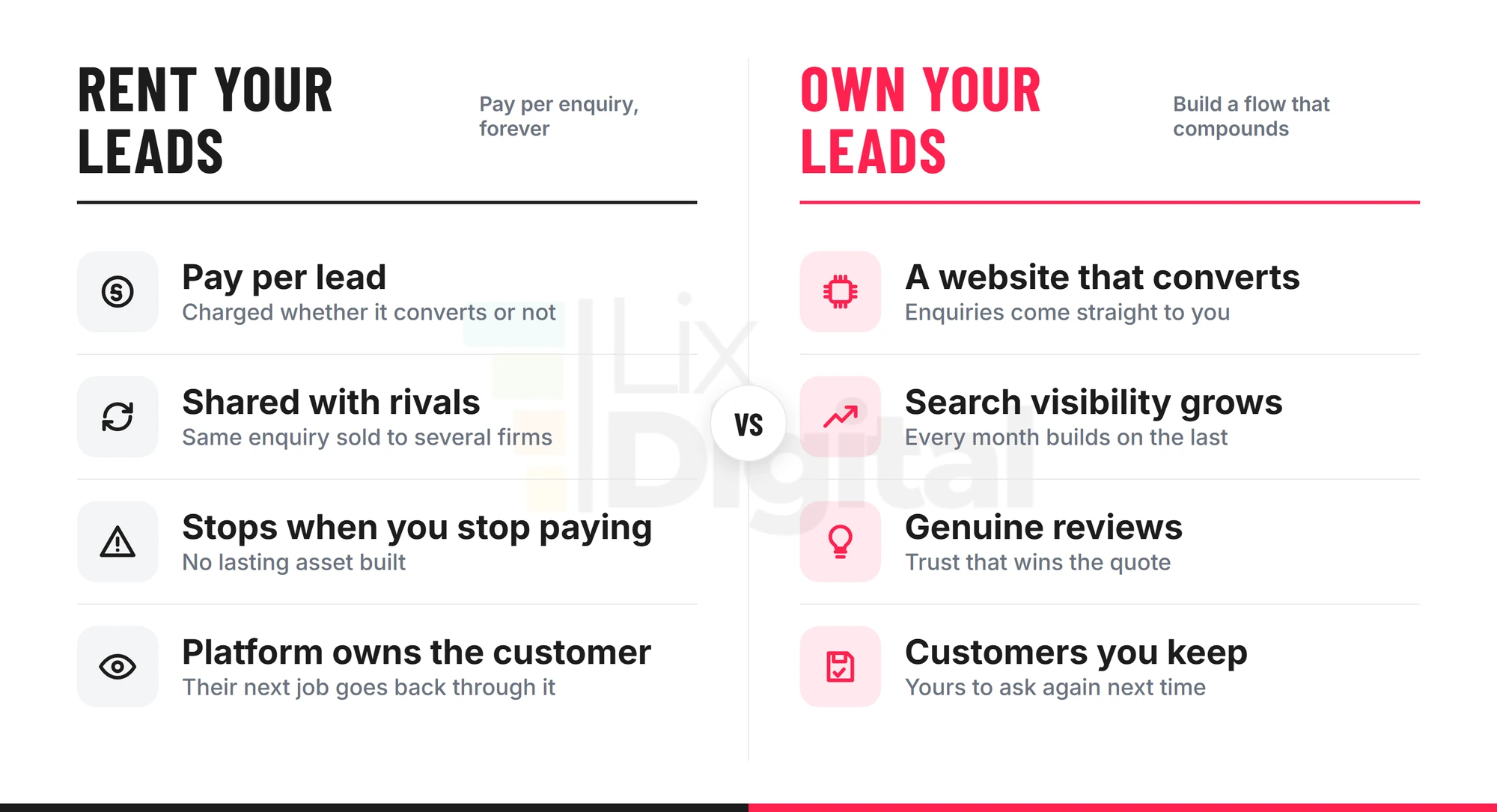
There are two ways to get leads — rent them or own them — and the difference decides how your business feels a few years from now. Renting means paying a directory or pay-per-lead platform, such as Checkatrade, MyBuilder or Rated People, to pass you enquiries. Owning means building your own marketing so that enquiries come straight to you. Most trades start by renting, because it is fast and needs no setup, and there is a fair case for it: a directory listing can fill a genuinely quiet week while you build something better.
Renting has a catch that never goes away. The lead you buy is rarely yours alone — the same enquiry is often sold to several firms at once, so you are bidding against your competitors on price before you have even spoken to the customer. You pay per lead whether or not it converts, and whether or not it was ever real, and you build no lasting asset: stop paying and the enquiries stop that day. Worst of all, the customer belongs to the platform, not to you, so their next job — and the neighbour they recommend — goes back through the directory rather than to your phone.
Owning your lead flow is slower to build and worth far more. A website that converts, visibility in search, a wall of real reviews, and paid ads you can switch on when you want work — these compound. Every month of SEO builds on the last, every review makes the next enquiry easier to win, and the customers are yours to keep and to ask again. We have sat on both sides of this: alongside our agency work we run our own trade and automotive businesses — ECU Repairs, Turbo Repairs and Bodyteq are ours — so we have felt the difference between chasing rented leads and owning the phone that rings. Directories have their place for filling a gap. They are a poor foundation to build a business on.
Start with a website that actually captures the enquiry
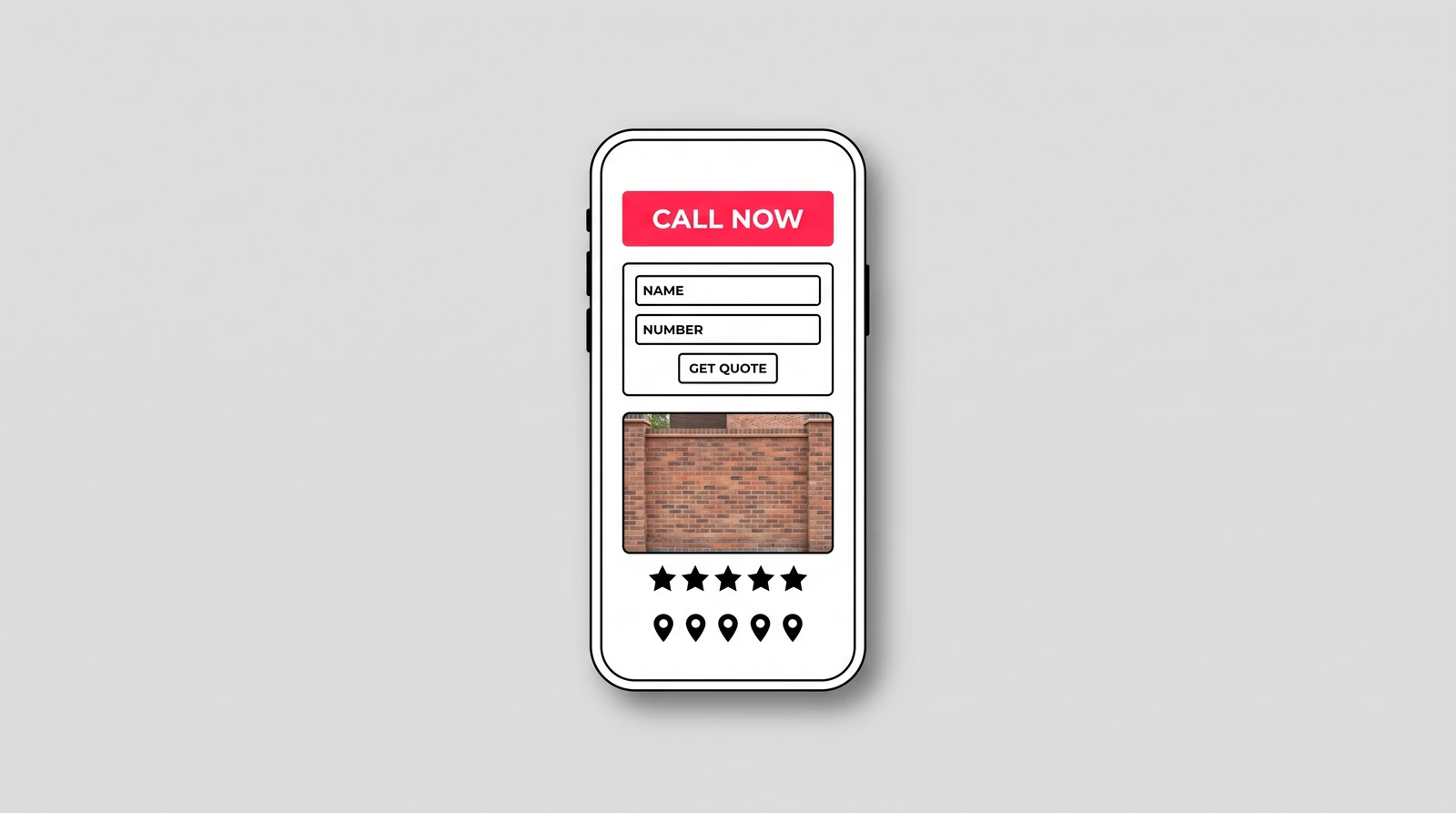
Every other channel you invest in — search, ads, social, referrals — sends people to one place: your website. It is the part of your marketing you fully own, and for many trades it is where hard-won enquiries quietly leak away. A site that loads slowly on a phone, hides the contact details, or leaves a homeowner unsure whether you even cover their area will lose the customer your visibility worked to win.
A trade website does not need to be elaborate; it needs to do a few things well. It should load fast and work on a phone first, because that is where nearly all your customers find you. Make the phone number tappable on every page, with a simple way to request a quote — a short form, not a twenty-field interrogation. State plainly what you do and the areas you cover, and carry the proof a cautious homeowner looks for: real photos of your work, genuine reviews, and any accreditations you actually hold. We build websites and WordPress sites in-house on UK-based servers, and active SEO clients get that hosting free for as long as they are with us; there is more on our web development page.
Get found: local and national search
When a homeowner needs a tradesperson and has no one to call, they search. “Electrician near me”, “emergency plumber in [town]”, “flat roof repair cost” — whoever appears, looks trustworthy and is easy to contact tends to get the enquiry. Search visibility puts your business in front of that person at the exact moment they have decided to hire, and unlike a rented lead it keeps working long after the effort is spent.
Most trades live on local demand, so local visibility does much of the heavy lifting. The foundation is your Google Business Profile — the free listing that places you on the map when someone searches nearby — kept claimed, complete and current, with recent photos of your work. Your website then reinforces the areas you serve and the jobs you do, so Google connects you to those local searches. Setting up and improving this local visibility is one of the main things we do for trade clients, precisely because a trade lives on local demand in a way many businesses do not.
Local is not the whole story. Broader searches — “how much does a rewire cost”, “signs you need a new roof” — reach people earlier in their decision, and ranking for those builds authority that lifts everything else. It compounds: every month of steady, white-hat SEO with clear reporting builds on the last, which is what quietly separates the trades that always have work from the ones that lurch between busy and empty. Our SEO services page explains how we approach it.
Reviews: the trust currency that wins the quote
Before a homeowner invites anyone onto their property, they check reviews. For a trade business, reviews are currency — they lift how prominently you appear in local search, and they are often the deciding factor between you and the firm down the road quoting a similar price. A wall of recent, genuine reviews reassures a nervous first-timer better than anything you can say about yourself.
The trades that win at reviews make asking part of the job — a friendly request when you finish and the customer is happiest, a follow-up text with a direct link, or a QR code on the invoice — rather than hoping people remember. Reply to every review, good or bad; a calm, professional response to a complaint reassures the next reader more than a flawless score with silence. Never buy fake reviews: they are easy to spot, against the rules, and they corrode the very trust you are trying to build.
When paid ads earn their keep (and when they don’t)
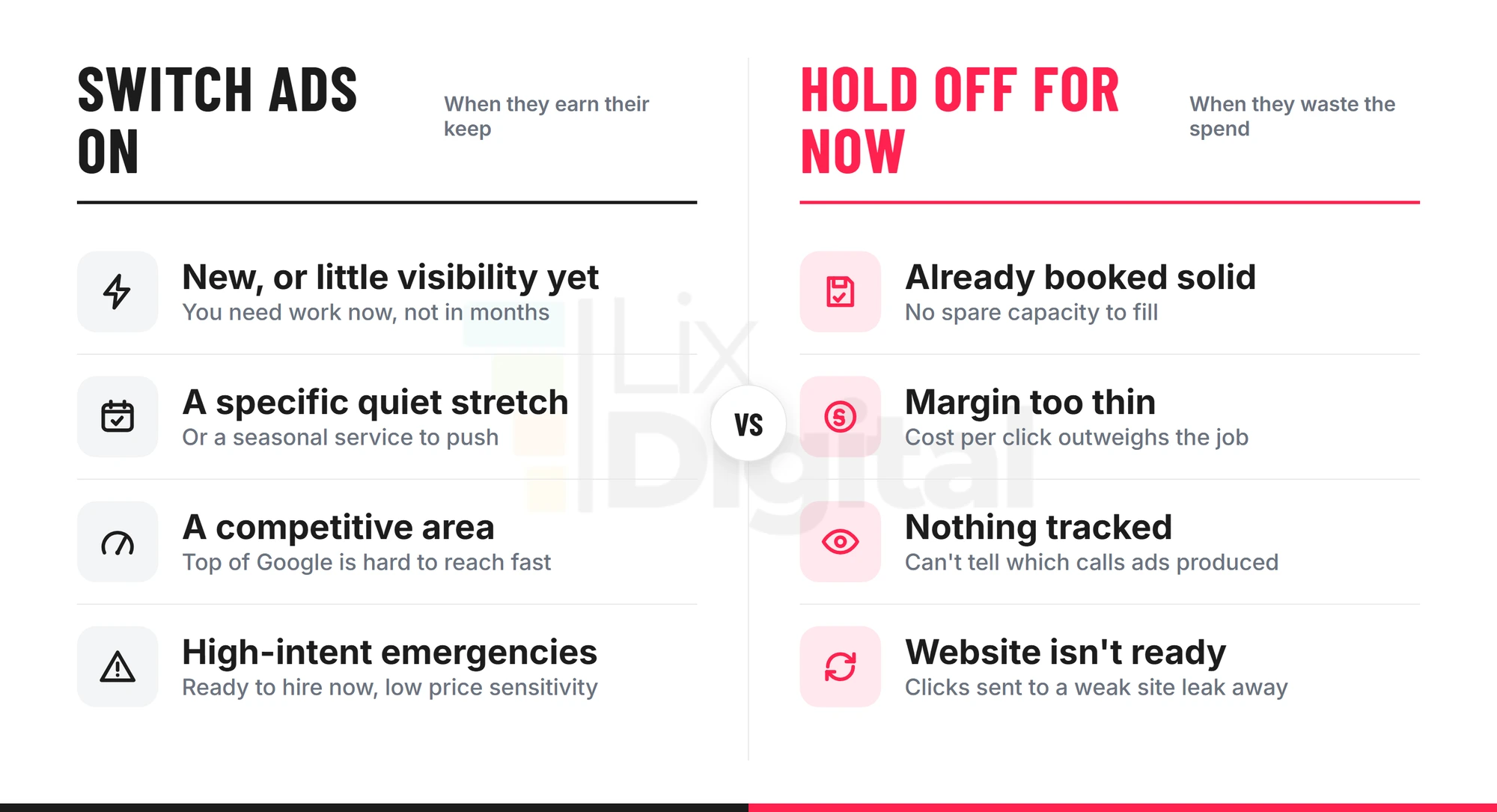
Search visibility compounds over months; paid ads buy visibility today. That makes them genuinely useful in the right circumstances and a waste in the wrong ones, and the honest answer to “should I run ads?” is: sometimes.
Ads earn their keep when you are newer and have little organic visibility but need work now; when you want to fill a specific quiet stretch or push a seasonal service; or when your area is competitive and the top of Google is hard to reach organically in the short term. They are especially worth it for high-intent emergency searches — “emergency electrician”, “burst pipe” — where the customer is ready to hire that hour and price sensitivity is low.
They are usually not worth it when you are already booked solid, when the margin on the advertised job is too thin to cover the cost per click, or when nothing tracks which calls the ads actually produced — spending money you cannot measure is how trades conclude that “marketing doesn’t work”. Sending paid clicks to a weak website wastes them twice over, which is why the website comes first. We recommend paid ads only where they fit your goals and margins, and manage them so every pound is accountable; our PPC management page covers how we run them.
Social media and project photos: proof that sells
For a trade, social media is proof more than promotion. Homeowners increasingly look you up on Facebook and Instagram before they get in touch, and a clean before-and-after photo does more to win a job than any slogan. Builders, roofers, landscapers, and bathroom and kitchen fitters have a natural advantage here: your work is visual, and a genuine transformation is compelling content that costs nothing but a photo taken before you start and another when you finish.
You do not need to be everywhere or become an entertainer. Pick one or two platforms your customers actually use, post real work consistently, and stay active in the community groups where people ask for recommendations. If posting regularly is one job too many alongside running the tools, that is exactly what an agency takes off your hands — our social media management page explains how.
Referrals and trade partnerships: your cheapest leads
Word of mouth built most trade businesses and still produces the warmest leads there are — yet many trades leave it entirely to chance. A simple habit of asking closes that gap: when a job goes well, tell the customer you would welcome a recommendation, leave a couple of cards, and stay in touch so you are the name they pass on. A small referral incentive can nudge it along.
The step most trades miss is partnering with other trades who serve the same customers but do not compete with you. An electrician, a plumber, a plasterer and a kitchen fitter all work in the same homes; a steady referral relationship between them turns each other’s customer bases into a shared source of qualified work, at no cost beyond a phone call and a follow-through. Build a handful of these relationships and jobs start to arrive that you never had to market for.
Speed to lead: why the first to reply usually wins
Every channel above is wasted if the enquiry sits unanswered. Homeowners who need work often contact two or three trades at once, and the one who replies first and professionally usually wins the job — not the cheapest, and not necessarily the best. A missed call at four o’clock that you return the next morning has frequently already gone to someone else.
You do not need to be glued to the phone to fix this. Enable notifications on your website enquiry form, use call forwarding or a simple answering service so calls are not lost when you are up a ladder, and set an honest expectation — even a quick “got your message, I’ll call you at five” holds the customer. Fast, professional first contact is the cheapest competitive advantage in the trades, and almost nobody does it consistently.
What to do first: a prioritised plan
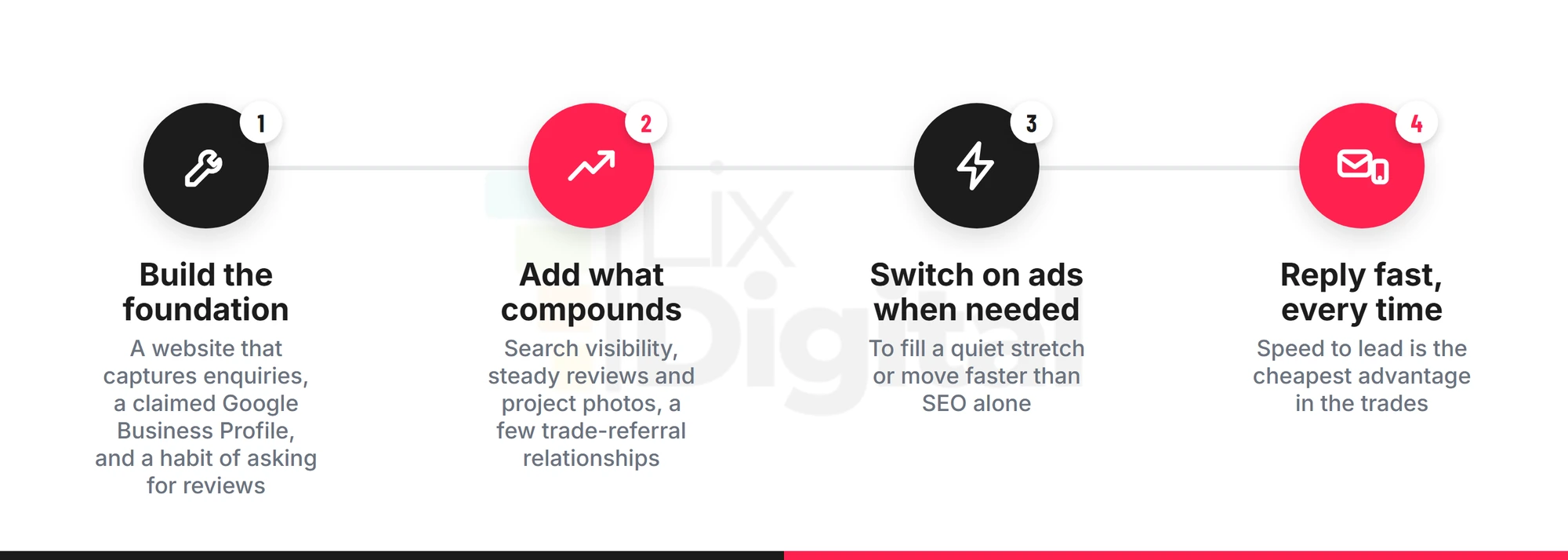
You do not need all of this at once, and trying to start everything at the same time is the surest way to finish none of it. The right order depends on where your business is now.
If you are just starting out or have little online presence, build the foundation first: a website that captures enquiries, a claimed and complete Google Business Profile, and a habit of asking every happy customer for a review. These cost little and underpin everything else. Get them right before you spend a penny on advertising, because ads sent to a weak site or an empty review page simply leak away.
Once the foundation is in place, add the channels that compound. Invest in search visibility so enquiries arrive without paying per lead, keep the reviews and project photos coming, and build a few trade-referral relationships. Switch on paid ads when you need work faster than SEO can deliver it, or to cover a quiet stretch — then ease off when the diary fills. Throughout, reply to every enquiry fast. That sequence is what moves a trade off rented leads and onto a flow of work it owns.
Trade lead generation questions, answered
What is the fastest way for a trade business to get more leads?
Paid search ads are the fastest lever — a well-targeted Google Ads campaign can bring enquiry calls within days, which is why they suit a new business or a sudden quiet spell. But fast and lasting are not the same thing: ads stop the moment you stop paying. The strongest approach is usually both at once — ads for the quick wins while the free, compounding channels (search visibility, reviews and referrals) build underneath them.
Are lead generation sites like Checkatrade worth it?
They can be, for a specific job — filling a genuinely quiet week, or testing demand in a new area. Where they fall short is as a foundation: you are usually buying the same lead as several competitors, paying per enquiry whether it converts or not, and building no asset of your own, because the customer belongs to the platform. Treat them as a short-term top-up, not the engine of your business, and put your real investment into the channels that bring enquiries directly to you.
How much should a trade business spend on marketing?
There is no flat figure, and any honest agency will scope it to what you actually need rather than sell a blanket package. A sole trader sharpening up a website and local visibility needs something very different from a firm chasing work across a county. The sensible approach is to start with the one or two things that move the needle fastest — usually the website and search visibility — prove they work, then build. Tell us about your business and we will give you a straight view of what is worth doing first.
Does SEO actually work for tradespeople?
Yes — for most trades it is the highest-return channel over time. When someone searches for your service in your area, appearing near the top puts you in front of a customer who has already decided to hire, and unlike a paid lead it keeps working after the job is done. It is not instant; it builds over months. That is precisely why it is worth starting sooner rather than later.
Should I handle marketing myself or hire an agency?
Plenty of trades make a good start themselves — claiming the Google listing, asking for reviews, posting real work on Facebook — and if you have the time, it is genuinely worthwhile. The catch is usually time: the marketing slips the moment the tools get busy, which is exactly when you need enquiries flowing. An agency earns its keep by making it consistent and accountable and handling the technical work — website, search visibility and paid ads — properly. As a team that runs its own trade and automotive businesses, we tend to see the job the way you do.
Final thoughts
Getting more leads for a trade business is not about luck or a clever trick — it is about being easy to find, easy to trust and easy to reach, then answering fast when someone gets in touch. The deeper choice underneath all of it is whether you rent your enquiries or own them. Renting fills a gap; owning builds a business, because a website that converts, visibility in search, real reviews and a few strong relationships compound month after month into work that comes straight to you. Start with the foundation, add the channels that build on themselves, switch paid ads on when you need them, and reply to every enquiry quickly. Do that consistently and the feast-or-famine cycle gives way to a diary that stays comfortably full.
If you would like a hand with any of this — or simply an honest view of the biggest opportunity for your trade business — we would be glad to talk it through. We help skilled trades through our trades work and the wider motor trade through our automotive work, as part of a full-service UK agency. Tell us where you are now and book a free consultation — no pressure, no jargon.