Ecommerce SEO That Makes Your Store Rank and Convert
An online store is one of the hardest kinds of website to rank — not because the rules of SEO change, but because there is so much more site to get right. A shop with a few hundred products can generate tens of thousands of URLs once filters, sort orders and variants multiply, and most of the rankings a store loses are lost to its own architecture rather than to a competitor. Ecommerce SEO, done properly, is an architecture problem before it is a content problem: get the structure right and your category and product pages both rank and convert; get it wrong and Google spends its time crawling pages you never wanted it to see. Lix Digital builds ecommerce SEO the same white-hat, fully-reported way we run every campaign in our SEO service — but this page gets specific about the structural work that actually decides whether an online store ranks.


Why ecommerce SEO is a different job
The fundamentals are the same as any SEO: relevant content, a sound technical base, and authority earned through links. What changes on an online store is the scale, and scale turns small problems into ranking-killers. A brochure site has a handful of pages that each need to be right. A store has a catalogue that grows, changes and goes out of stock, filters that spawn near-endless URL variations, and product descriptions that are often identical to a hundred competitors selling the same item from the same manufacturer.
On top of that, ecommerce pages carry a double burden the rest of the web does not. A blog post only has to rank. A product page has to rank and then convince the visitor to buy — and the two goals sometimes pull in different directions. The store that wins is the one whose structure works with Google instead of against it, and whose product pages are built to close the sale once the visitor arrives. Everything below is aimed at those two outcomes.
The architecture problems that quietly sink online stores
This is where most ecommerce SEO is won or lost, and it is the part cheaper agencies skip because it is invisible to the untrained eye. Your store can have perfect product copy and still stall if search engines cannot crawl it efficiently or cannot tell which of your pages matters. These are the structural faults we look for first.
Category-page architecture
Category pages are usually your most valuable ranking asset, and the ones stores most often neglect. They target the broad, high-intent terms people actually search — “running trainers”, “oak dining tables” — where an individual product page rarely competes. We structure your catalogue so any product is reachable from the homepage in a few clicks, name categories around the terms your customers use, and give each category page enough genuine, well-written content to rank rather than leaving it as a bare grid of thumbnails. Get the category layer right and it pulls the whole store up with it.
Faceted navigation and product filters
Filters — size, colour, price, brand — are a gift to shoppers and a trap for SEO. Every combination a customer can select can generate its own URL, and left unmanaged those parameter URLs multiply into thousands of near-duplicate pages. The damage is twofold: search engines burn your crawl budget indexing filtered variants instead of the pages you care about, and your index fills with thin, duplicated pages that drag on the whole site. We control it deliberately — deciding which filtered pages deserve to be indexed because they match real search demand, and using canonical tags, robots directives and parameter handling to keep the rest out of the index without breaking the shopping experience.
Duplicate and thin product content
Two things quietly flood most stores with duplicate content. The first is the manufacturer’s description, copied verbatim onto your product page and a hundred rivals’ pages — which gives Google no reason to favour yours. The second is product variants, where a single item in eight colours becomes eight almost-identical URLs. We tackle both: prioritising unique, useful descriptions for your highest-value and best-selling products first, where the return is greatest, and using canonical tags to consolidate variant and near-duplicate URLs so ranking signals point at one strong page instead of scattering across several weak ones.
URL structure, site depth and internal links
Clean URLs and shallow site depth do quiet, cumulative work. Descriptive, keyword-aware URLs — /sweaters/lambswool-crew-neck rather than /category/id=323551 — help both search engines and shoppers understand a page before they open it, and a shallow structure means link authority flows to your products in a couple of hops instead of getting lost six levels down. Internal linking ties it together: category-to-subcategory-to-product links, plus related-product and “customers also bought” links, tell Google which pages matter and keep shoppers moving through the store. On a large catalogue, internal linking is one of the most under-used ranking levers there is.
Product pages engineered to rank and convert
Once the architecture is sound, the product page has to do its double job. We optimise the elements that earn the ranking and the elements that earn the sale, because on an online store they are the same page and there is no point winning the click if the page then loses the customer.
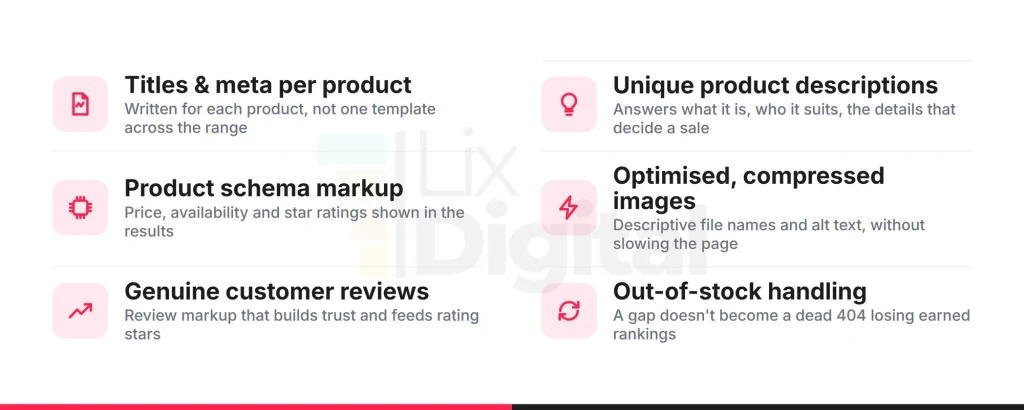
- Titles and meta descriptions written per product — the specific product name and its key selling point, not a template that reads the same across your whole range — to lift both rankings and click-through from the results.
- Unique product descriptions that answer the questions a buyer actually has: what it is, who it suits, the details that decide a purchase. This is where you beat the identikit manufacturer copy your competitors are still running.
- Product schema markup so Google can show price, availability and star ratings directly in the results. Those rich snippets make your listing stand out against plain blue links and can lift click-through before a shopper has even reached your site.
- Optimised, compressed images with descriptive file names and alt text — earning a place in image search, aiding accessibility, and keeping the page fast enough not to lose the sale to a slow load.
- Genuine customer reviews on the page, with review markup, to build the trust that converts browsers into buyers and to feed the rating stars into your search listing.
- Sensible handling of out-of-stock and discontinued products, so a temporary gap does not become a dead 404 that wastes the ranking authority the page has already earned.
That last point matters more than most stores realise. Conversion work and SEO are not separate projects on an ecommerce site — a clearer product page, a faster load and a smoother path to the basket improve both your rankings and your sales at once, so we treat them as one job rather than two.
The technical foundations a store has to get right
Scale makes technical SEO non-negotiable for an online store. The more pages you have, the more chances there are for something to break, and the more it costs you when it does. We audit and fix the foundations that everything else sits on.
Page speed and Core Web Vitals come first, because a slow store loses shoppers before it loses rankings — and on mobile, where a growing share of shopping now happens, the tolerance for a slow page is even lower. We work through the usual culprits: heavy images, render-blocking scripts, bloated code and weak caching. We confirm your store runs on HTTPS end to end, keep your XML sitemaps clean so Google can find every page worth indexing, and manage crawling and indexing so search engines spend their effort on your money pages rather than your internal search results or thank-you pages. If you sell across borders, we implement hreflang correctly so your regional pages do not end up competing with, or duplicating, each other.
Because Lix Digital is a full-service UK agency, our web development team can implement these fixes directly in your store rather than handing you a report and leaving you to find a developer who understands it. That closes the gap where most ecommerce SEO recommendations quietly die — between the audit and someone actually making the change.


Content and keyword strategy for online stores
Not every shopper is ready to buy on the first visit, and your content has to meet them at each stage. Keyword research is the starting point: we map the commercial and transactional terms — the ones with buying intent — to your category and product pages, where they belong, and route the informational searches to content built for that purpose.
A blog or buying-guide section does two jobs for a store. It captures the earlier, research-stage searches your product pages will never rank for — comparisons, “how to choose”, best-of round-ups — and it gives you a natural place to link internally to the categories and products those readers are heading towards. Done well, content marketing also earns the links and brand mentions that lift your whole domain. It is the difference between waiting for buyers to arrive and meeting them while they are still deciding.
Links and authority, earned safely
Links from reputable sites remain one of the strongest signals behind where you rank, and for a store competing against established retailers they often decide who wins the category terms. We build authority the white-hat way — through genuinely useful content, digital PR, supplier and distributor links you are entitled to as an official stockist, and reclaiming brand mentions that should already be links. We never touch bought links, link farms or the schemes that earn a short-term bump and a long-term penalty. On an asset as valuable as your storefront, that risk is never worth taking.

How we run an ecommerce SEO campaign
Every store is different, so we do not run a fixed package. We do follow the same disciplined sequence, weighted to what your catalogue and market actually need, and we show you the reasoning at every step rather than asking you to take it on trust.
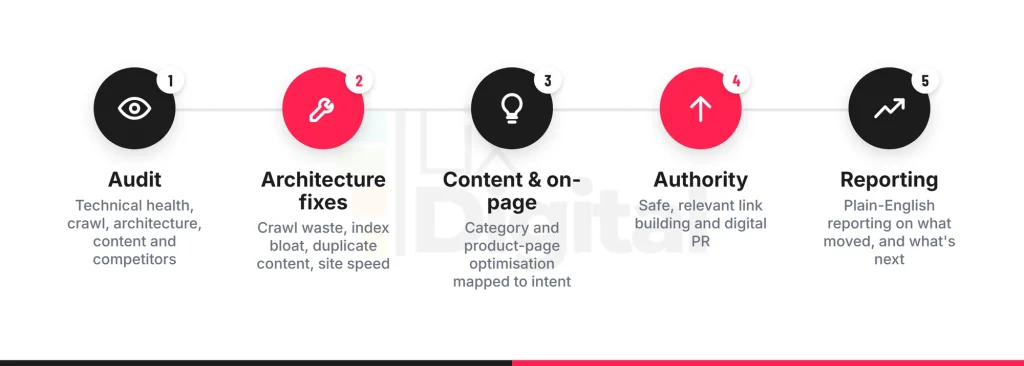
- Audit. A full review of your store’s technical health, crawl and indexation, category and filter structure, content and current rankings, plus the competitors ahead of you — so we know exactly what is holding the site back before we touch anything.
- Architecture and technical fixes. We resolve the structural faults first — crawl waste, index bloat from filters, duplicate content, site speed — because they are what cap the ceiling on everything else.
- Content and on-page. Category and product-page optimisation, unique descriptions for your priority products, and supporting content mapped to real search intent.
- Authority. Safe, relevant link building and digital PR to strengthen the domain and compete for the terms that matter most.
- Reporting. Clear, plain-English reporting on what we did, what moved in your rankings and organic traffic, and what comes next — with no hiding behind vanity metrics when a month is slow.
How ecommerce SEO pricing works
We would rather explain how pricing works than hide it behind a form. Ecommerce SEO is almost always sold as a monthly service, because it is ongoing work rather than a one-off fix, and the fee reflects the size of your catalogue, how competitive your market is and how much your store needs putting right.
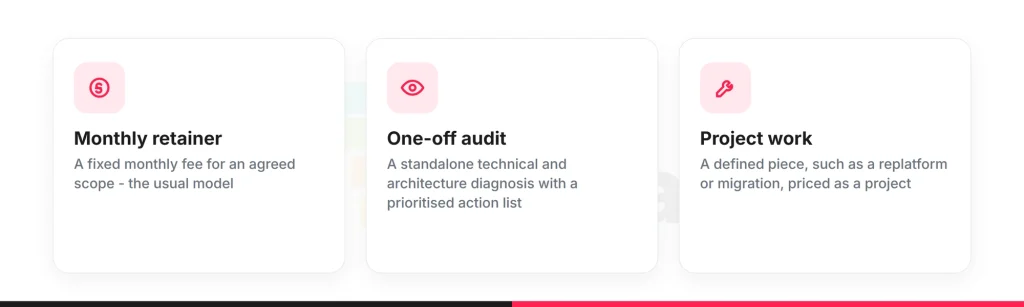
- Monthly retainer — the usual model: a fixed monthly fee for an agreed scope. Across the UK these range from a few hundred pounds a month for a smaller store in a low-competition niche to several thousand a month for large catalogues in competitive sectors, where the technical and content workload is far heavier.
- One-off audit — a standalone technical and architecture audit for a store that wants an expert diagnosis and a prioritised action list before committing to ongoing work.
- Project work — a defined piece such as a replatforming or migration, priced as a project rather than a rolling retainer.
We keep our fees deliberately competitive and recommend the level of investment that genuinely fits your store, not the one that maximises our invoice. And be wary of anyone promising guaranteed number-one rankings for a fixed low fee — no one can guarantee a position on Google, and the tactics used to chase that promise are the ones that get stores penalised.
Why choose Lix Digital for ecommerce SEO
The right partner for your store is one who fixes the structural work most agencies skip, can actually implement the changes rather than just recommend them, and shows you the working every step of the way. Here is what that looks like with us.
- We fix the architecture, not just the copy. Category structure, faceted navigation, duplicate content and crawl control are where ecommerce rankings are really won — and they are exactly the work thinner agencies leave out.
- One agency that can build as well as advise. Because we run web and WordPress development in-house, we implement technical and architecture fixes directly in your store rather than handing you a report to pass to someone else.
- White-hat and fully reported. Every technique we use is safe for the long-term health of your store, and every month you see precisely what we did and what it changed.
- Free UK hosting while you’re with us. Take on an SEO campaign and we host your store free on our UK-based servers for as long as you stay — often for less than you pay now — and include free access to Lix Shield, our WordPress security plugin, for the life of the campaign.
- Priced to compete, and national. Our fees are scoped to what your store genuinely needs, and we work with online retailers across the UK as a national online agency, with a UK-based support team behind the work.

Ecommerce SEO questions, answered
The stores that win in search are rarely the ones with the biggest content budget — they are the ones whose structure is not fighting them. Fix the category architecture, tame the filters, kill the duplicate content, and build product pages that rank and then convert, and the rest of your SEO has firm ground to stand on. That is the work we lead with, done the white-hat way and reported in plain English, with a full agency behind it so the fixes actually get made rather than filed. If you would like to know what is holding your store back and what it would take to move it up, we will take a proper look and tell you straight.
Want to know where your store ranks today and what is capping it? Tell us about your business and your catalogue, and we will review your site and come back with an honest assessment and a competitive proposal. Get a free SEO review.